Discover Resources
Browse curated homeschool resources from the community

Real Life Alien Jaws Darien Satterfield
After stalking a cuttlefish, a moray eel finally pounces. As the eel snags the mollusk in its teeth, its prey struggles to escape. But before it can wiggle away, a second set of teeth lunge from the eel’s throat. This adaptation is called a pharyngeal jaw, and is one of the most common adaptations under the sea. Darien Satterfield shares how this incredible skeletal mechanism works.
Why Doesn T Anything Stick to Teflon Ashwini Bharathula
Teflon was in the spacesuits the Apollo crew wore for the moon landing, in pipes and valves used in the Manhattan project, and it may be in your kitchen, as the nonstick coating on frying pans and cookie sheets. So what is this slippery solid — and why doesn’t anything stick to it? Ashwini Bharathula describes the science behind Teflon.

Ethical Dilemma the Burger Murders George Siedel and Christine Ladwig
You founded a company that manufactures meatless burgers that are sold in stores worldwide. But you’ve recently received awful news: three people in one city died after eating your burgers. A criminal has injected poison into your product! The deaths are headline news and sales have plummeted. How do you deal with the crisis? George Siedel and Christine Ladwig explore the different strategies of this ethical dilemma.
A Day in the Life of an Ancient Babylonian Business Mogul Soraya Field Fiorio
It’s 1762 BCE. As dawn breaks in the Babylonian city of Sippar, Beltani— a priestess and businesswoman— receives an urgent visit from her brother. He makes a troubling accusation: her tavern keeper has been undermining the business Beltani relies on in her old age. Now she has just a few short hours to find out the truth. Soraya Field Fiorio details a day in the life of a Babylonian naditu.
Why Isn T the World Covered in Poop Eleanor Slade and Paul Manning
Each day, the animal kingdom produces roughly enough poop to match the volume of water pouring over Victoria Falls. So why isn’t the planet covered in the stuff? You can thank the humble dung beetle for eating up the excess. Eleanor Slade and Paul Manning explain how these valiant insects make quick work of an endless stream of feces.
Is it Normal to Talk to Yourself
Being caught talking to yourself can feel embarrassing, and some people even stigmatize this behavior as a sign of mental instability. But decades of research show that talking to yourself is completely normal; most if not all of us engage in some form of self-talk every day. So why do we talk to ourselves? And does what we say matter? Dig into the psychological benefits of positive self-talk.

Is Human Evolution Speeding Up or Slowing Down Laurence Hurst
In the past 3,000 years, many populations have evolved genetic adaptations to their local environments. People in Siberia and the high arctic are uniquely adapted to survive extreme cold. The Bajau people can dive 70 meters and stay underwater for almost 15 minutes. So what are other recent changes? And will our technological innovations impact our evolution? Laurence Hurst investigates.

Why is Pneumonia so Dangerous Eve Gaus and Vanessa Ruiz
Every time you breathe, air travels down the trachea, through a series of channels, and then reaches little clusters of air sacs in the lungs. These tiny sacs facilitate a crucial exchange: allowing oxygen from the air we breathe into the bloodstream and clearing out carbon dioxide. Pneumonia wreaks havoc on this exchange system. Eve Gaus and Vanessa Ruiz detail how pneumonia attacks the lungs.

Can You Solve the Sorting Hat Riddle Dan Katz and Alex Rosenthal
It’s your first day at Magnificent Marigold’s Magical Macademy. But before you can learn your first spell you must get through the sorting ceremony. And the sorting hat has chosen you for a special challenge. The Macademy had 8 founders who established four houses, and there was once a mysterious fifth house. Can you figure out who founded what? Dan Katz and Alex Rosenthal show how.

Can You Win a Game of Quantum Foosball Matteo Fadel
After a long day working on the particle accelerator, you and your friends head to the arcade to unwind. The lights go out for a second, and when they come back, there before you gleams a foosball table. Always game, you insert your coins. And quantum foosball begins— instead of a ball, you’ll be playing with a giant electron. Matteo Fadel shows how to use quantum mechanics to your advantage.
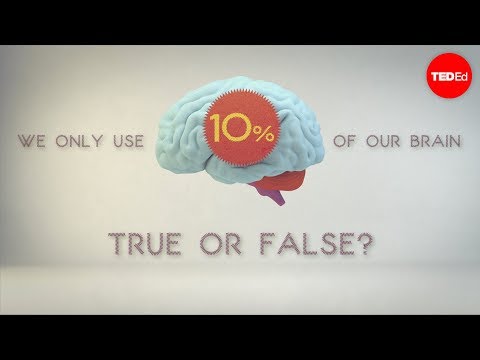
What Percentage of Your Brain Do You Use Richard E Cytowic
Two thirds of the population believes a myth that has been propagated for over a century: that we use only 10% of our brains. Hardly! Our neuron-dense brains have evolved to use the least amount of energy while carrying the most information possible -- a feat that requires the entire brain. Richard E. Cytowic debunks this neurological myth (and explains why we aren’t so good at multitasking).

The Pattern Behind Self Deception Michael Shermer
Michael Shermer says the human tendency to believe strange things -- from alien abductions to dowsing rods -- boils down to two of the brain's most basic, hard-wired survival skills. He explains what they are and how they get us into trouble.
The Dark History of Bananas John Soluri
In December 1910, the exiled former leader Manuel Bonilla boarded a borrowed yacht and set sail for Honduras in hopes of reclaiming power by whatever means necessary. Bonilla had a powerful backer: the notorious organization known throughout Latin America as “El Pulpo.” It was a U.S. corporation trafficking in, of all things, bananas. John Soluri investigates the United Fruit Company.

Did the Amazons Really Exist Adrienne Mayor
It was long assumed that Amazons, the fierce and fearsome women warriors of Greece, were imaginary. But curiously enough, stories from ancient Egypt, Persia, the Middle East, Central Asia, India and China also featured Amazon-like warrior women. And Amazons were described in ancient historical accounts, not just myths. Who were the real women warriors known as Amazons? Adrienne Mayor investigates.

Why We Need National Parks Elyse Cox
In 1903, US President Theodore Roosevelt took a camping trip in California’s Yosemite Valley with conservationist John Muir. Roosevelt famously loved the outdoors, but Muir had invited him for more than just camping: Yosemite was in danger. It was part of a struggle to set aside land for both preservation and public use. Elyse Cox details the delicate balancing act of creating a national park.
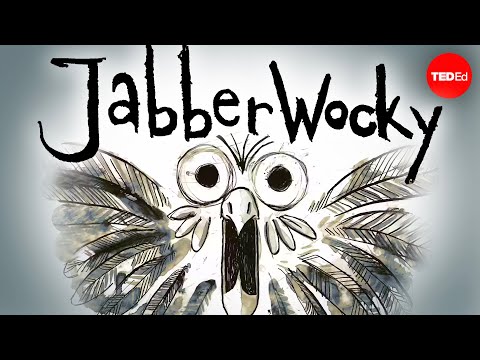
Jabberwocky One of Literature s Best Bits of Nonsense
As Alice wanders through the dreamscape of Looking-Glass Land in Lewis Carroll's "Through the Looking-Glass, and What Alice Found There," she happens across a book written in an unintelligible language. Inside, she discovers an epic poem filled with nonsense, fearsome creatures, and whimsical language. Dive into Carroll's legendary poem, "Jabberwocky" and see if you can make sense of the nonsense.