Discover Resources
Browse curated homeschool resources from the community
Why should you read "One Hundred Years of Solitude"? - Francisco Díez-Buzo
Explore Gabriel García Márquez's magical realist masterpiece.

Why should you read "Hamlet"? - Iseult Gillespie
Discover the enduring power of Shakespeare's masterpiece.

TED-Ed: How Did Dracula Become the World's Most Famous Vampire?
Over a hundred years after his creator was laid to rest, Dracula lives on as the most famous vampire in history. But this Transylvanian noble – neither the first fictional vampire, nor the most popular of his time – may have remained buried in obscurity if not for a twist of fate. Stanley Stepanic explains how a critical copyright battle catapulted Bram Stoker’s character into literary renown.
TED-Ed: Plato's Allegory of the Cave
Twenty four hundred years ago, Plato, one of history’s most famous thinkers, said life is like being chained up in a cave forced to watch shadows flitting across a stone wall. Beyond sounding quite morbid, what exactly did he mean? Alex Gendler unravels Plato's Allegory of the Cave, found in Book VII of The Republic.

TED-Ed: Everything You Need to Read Homer's Odyssey
An encounter with a man-eating giant. A sorceress who turns men into pigs. A long-lost king taking back his throne. On their own, any of these make great stories. But each is just one episode in the "Odyssey," a 12,000-line poem spanning years of ancient Greek history and legend. So how do we make sense of this massive text? Jill Dash shares everything you need to know to read Homer's "Odyssey.”
Why should you read “Lord of the Flies” by William Golding? - Jill Dash
William Golding's dark exploration of human nature.
Why should you read “Fahrenheit 451”? - Iseult Gillespie
Ray Bradbury's warning about censorship and conformity.

TED-Ed: The Pleasure of Poetic Pattern
Humans are creatures of rhythm and repetition. From our breath to our gait: rhythm is central to our experience, and often brings us pleasure. We can find pleasure in the rhythm of a song, or even the rows of an orchard. Of course, too much repetition can also backfire. David Silverstein describes what poetic repetition is and why it works.

TED-Ed: Comma Story
It isn't easy holding complex sentences together (just ask a conjunction or a subordinate), but the clever little comma can help lighten the load. But how to tell when help is really needed? Terisa Folaron offers some tricks of the comma trade.
TED-Ed: How to Communicate Clearly
This is episode 3 of the animated series, “Public Speaking 101.” Ideas change everything — and since language lets us share our ideas, learning how to use it well gives speakers the power to inspire people and even change how they think. This 11-episode course will teach you how to identify, develop, and share your best ideas, while mastering essential communication skills along the way.


TED-Ed: Why You Should Read The God of Small Things
Set in a small town in India, “The God of Small Things” revolves around fraternal twins Rahel and Estha, who are separated for 23 years after the fateful hours in which their cousin drowns, their mother’s affair is revealed, and her lover is murdered. The book is set at the point of the twins’ reunion and confronts the social mores of India. Laura Wright dives into Arundhati Roy’s masterful storytelling.

TED-Ed: Why You Should Read Don Quixote
Mounting his skinny steed, Don Quixote charges an army of giants. It is his duty to vanquish these behemoths in the name of his beloved lady, Dulcinea. There’s only one problem: the giants are merely windmills. What is it about this tale of the clumsy yet valiant knight that makes it so beloved? Ilan Stavans investigates.
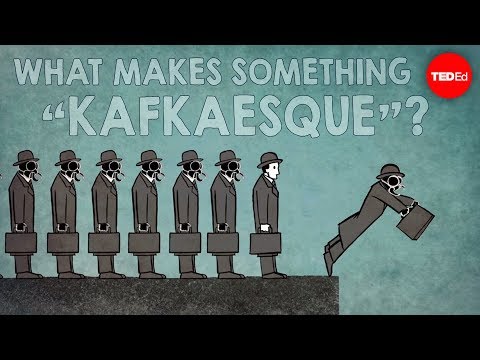
TED-Ed: What Makes Something Kafkaesque?
The term Kafkaesque has entered the vernacular to describe unnecessarily complicated and frustrating experiences, especially with bureaucracy. But does standing in a long line to fill out confusing paperwork really capture the richness of Kafka’s vision? Beyond the word’s casual use, what makes something "Kafkaesque"? Noah Tavlin explains.

TED-Ed: Mining Literature for Deeper Meanings
Writing a great English paper can be tough because literature doesn’t always reveal its deeper meanings immediately. You might not know Mr. Darcy’s true feelings for Elizabeth Bennett in Jane Austen’s Pride and Prejudice or grasp the complex moral universe of Toni Morrison’s Beloved at first reading. Amy E. Harter offers a few tips on how to read and write more critically and thoughtfully.
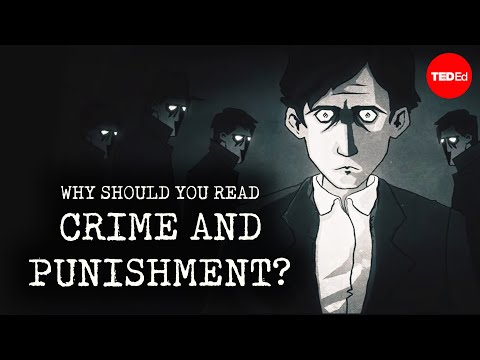
TED-Ed: Why You Should Read Crime and Punishment
What drives someone to kill in cold blood? What goes through the murderer’s mind? And what kind of a society breeds such people? Over 150 years ago Fyodor Mikhailovich Dostoyevsky took these questions up in what would become one of the best-known works of Russian literature: “Crime and Punishment.” Alex Gendler digs into the classic novel's exploration of alienation, morality and redemption.

TED-Ed: Why You Should Read Dune
A mother and son trek across an endless desert. Wearing special suits to dissipate heat and recycle moisture, the travelers aren’t worried about dying of thirst. Their fears are much greater. Soon, the sound of the desert is drowned out by a hissing: a mound of sand 400 meters long bursts from the desert floor and races towards them. This is the world of “Dune.” Dan Kwartler dives into the epic story.
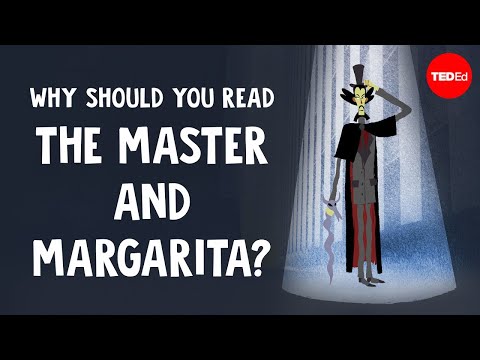
TED-Ed: Why You Should Read The Master and Margarita
The Devil has come to town. But don’t worry– all he wants to do is stage a magic show. This absurd premise forms the central plot of Mikhail Bulgakov’s masterpiece, “The Master and Margarita.” Its blend of political satire, historical fiction and occult mysticism has earned a legacy as one of the 20th century’s greatest novels– and one of its strangest. Alex Gendler explores the subversive novel.
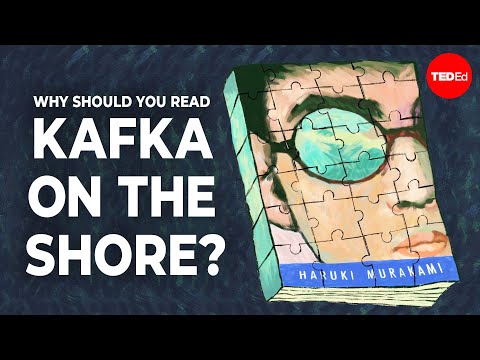
Why Should You Read Kafka on the Shore Iseult Gillespie
Desperate to escape his tyrannical father and the family curse he feels doomed to repeat, Haruki Murakami’s teenage protagonist renames himself “Kafka” after his favorite author and runs away from home. So begins “Kafka on the Shore”— an epic literary puzzle filled with time travel, hidden histories and magical underworlds. Iseult Gillespie dives into Murakami’s mind-bending and whimsical novel.

What Makes a Hero Matthew Winkler
What trials unite not only Harry Potter or Frodo Baggins but many of literature's most interesting heroes? And what do ordinary people have in common with these literary heroes? Matthew Winkler takes us step-by-step through the crucial events that make or break a hero.

The Wicked Wit of Jane Austen Iseult Gillespie
Whether she’s describing bickering families, quiet declarations of love, or juicy gossip, Jane Austen’s writing often feels as though it was written just for you. Her dry wit and cheeky playfulness informs her heroines, whose conversational tone welcomes readers with a conspiratorial wink. Iseult Gillespie explores the sly societal satire and unique tongue-in-cheek humor of Jane Austen.

How to Read Music Tim Hansen
Like an actor’s script, a sheet of music instructs a musician on what to play (the pitch) and when to play it (the rhythm). Sheet music may look complicated, but once you've gotten the hang of a few simple elements like notes, bars and clefs, you're ready to rock. Tim Hansen hits the instrumental basics you need to read music.
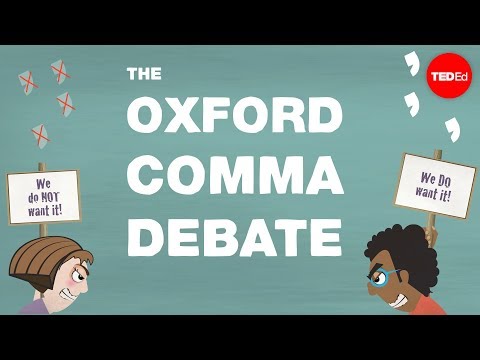
Grammar s Great Divide the Oxford Comma Ted Ed
If you read "Bob, a DJ and a clown" on a guest list, are three people coming to the party, or only one? That depends on whether you're for or against the Oxford comma -- perhaps the most hotly contested punctuation mark of all time. When do we use one? Can it really be optional, or is there a universal rule? TED-Ed explores both sides of this comma conundrum.