Discover Resources
Browse curated homeschool resources from the community
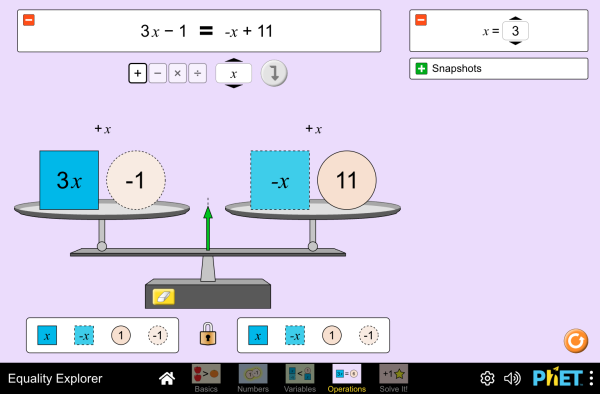
PhET: Equality Explorer
Explore what it means for a mathematical statement to be balanced or unbalanced by interacting with objects on a balance. Discover the rules for keeping it balanced. Collect stars by playing the game!
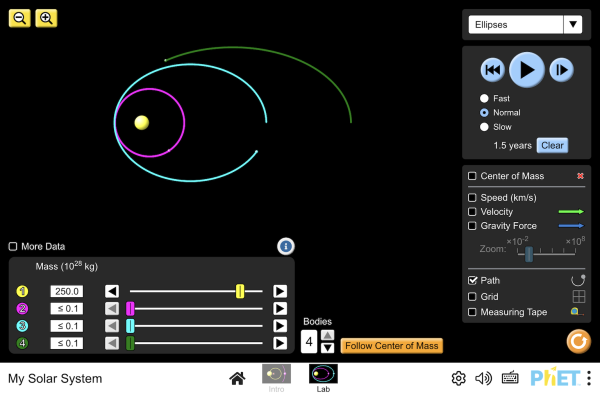
PhET: My Solar System
Build your own system of heavenly bodies and watch the gravitational ballet. With this orbit simulator, you can set initial positions, velocities, and masses of 2, 3, or 4 bodies, and then see them orbit each other.
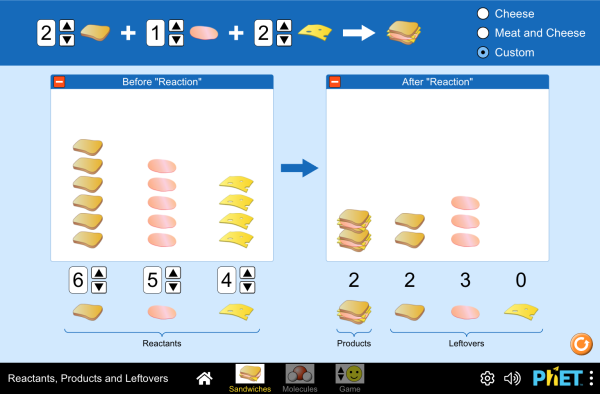
PhET: Reactants, Products and Leftovers
Create your own sandwich and then see how many sandwiches you can make with different amounts of ingredients. Do the same with chemical reactions. See how many products you can make with different amounts of reactants. Play a game to test your understanding of reactants, products and leftovers. Can you get a perfect score on each level?
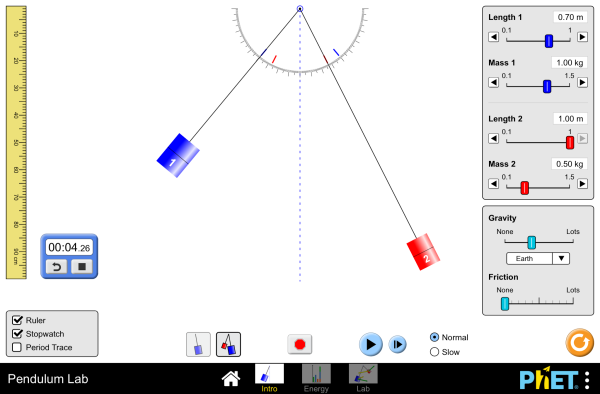
PhET: Pendulum Lab
Play with one or two pendulums and discover how the period of a simple pendulum depends on the length of the string, the mass of the pendulum bob, the strength of gravity, and the amplitude of the swing. Observe the energy in the system in real-time, and vary the amount of friction. Measure the period using the stopwatch or period timer. Use the pendulum to find the value of g on Planet X. Notice the anharmonic behavior at large amplitude.
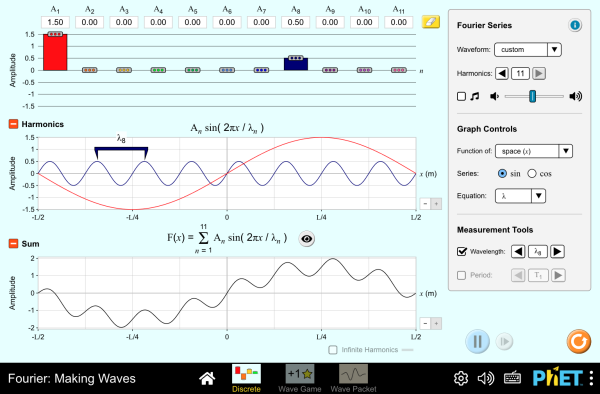
PhET: Fourier: Making Waves
Add up sines or cosines to make waves of different shapes. Discover how changing the amplitudes of different harmonics changes the sound you hear. Play the Wave Game and combine harmonics to match a target waveform. Construct wave packets and explore the effects of changing the spacing between Fourier components and wave packet width.
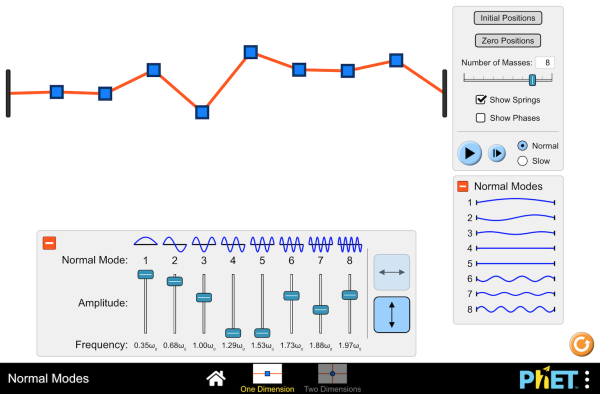
PhET: Normal Modes
Play with a 1D or 2D system of coupled mass-spring oscillators. Vary the number of masses, set the initial conditions, and watch the system evolve. See the spectrum of normal modes for arbitrary motion. See longitudinal or transverse modes in the 1D system.
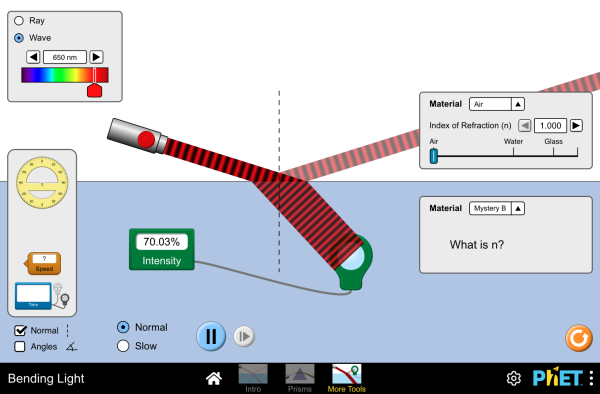
PhET: Bending Light
Explore bending of light between two media with different indices of refraction. See how changing from air to water to glass changes the bending angle. Play with prisms of different shapes and make rainbows.
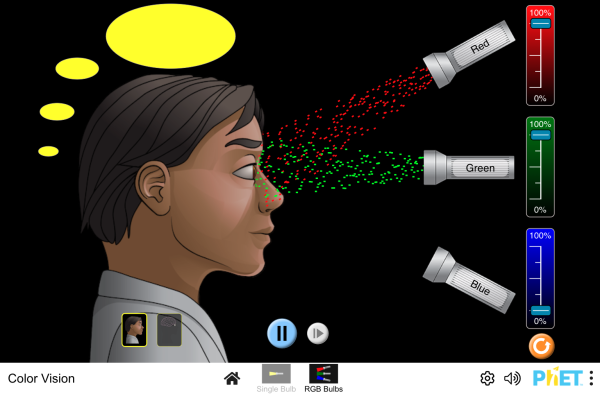
PhET: Color Vision
Make a whole rainbow by mixing red, green, and blue light. Change the wavelength of a monochromatic beam or filter white light. View the light as a solid beam, or see the individual photons.
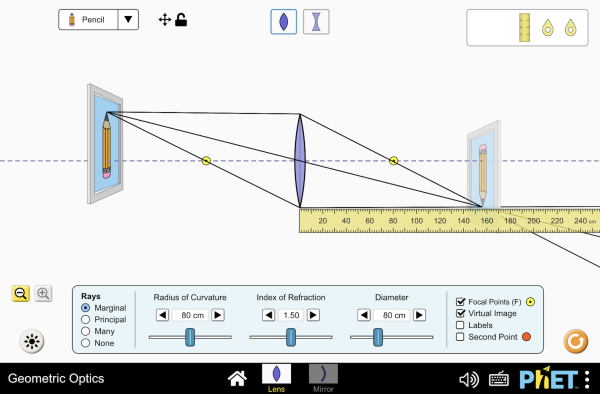
PhET: Geometric Optics
How does a lens or mirror form an image? See how light rays are refracted by a lens or reflected by a mirror. Observe how the image changes when you adjust the focal length of the lens, move the object, or move the screen.
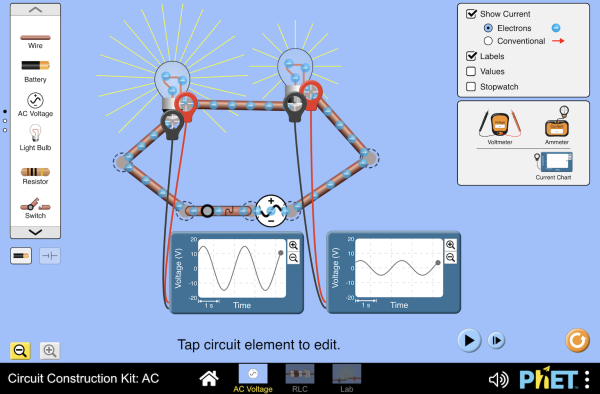
PhET: Circuit Construction Kit: AC
Experiment with an electronics kit! Build circuits with batteries, resistors, ideal and non-Ohmic light bulbs, fuses, and switches. Build circuits with AC voltage sources, batteries, resistors, capacitors, inductors, fuses, and switches. Take measurements with a lifelike ammeter and voltmeter and graph the current and voltage as a function of time. View the circuit as a schematic diagram or switch to a lifelike view.
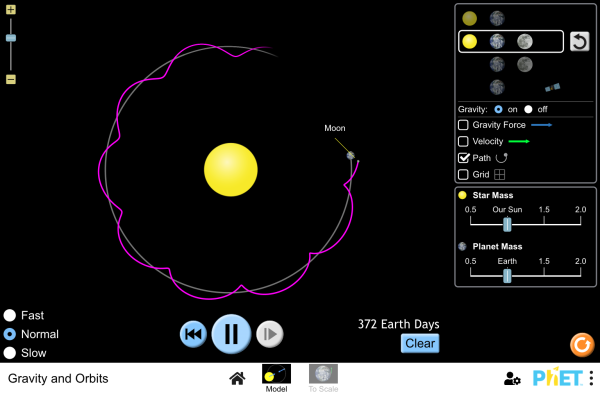
PhET: Gravity and Orbits
Move the sun, earth, moon and space station to see how it affects their gravitational forces and orbital paths. Visualize the sizes and distances between different heavenly bodies, and turn off gravity to see what would happen without it!

TED-Ed: Philosophy Lessons
TED-Ed celebrates the ideas of teachers and students around the world. Discover hundreds of animated lessons, create customized lessons, and share your big ideas.

PhET: Geometric Optics: Basics
How does a lens or mirror form an image? See how light rays are refracted by a lens or reflected by a mirror. Observe how the image changes when you adjust the focal length, move the object, or move the screen.
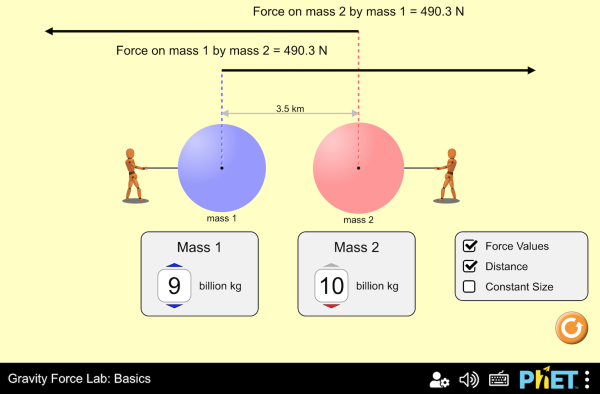
PhET: Gravity Force Lab: Basics
Visualize the gravitational force that two objects exert on each other. Discover the factors that affect gravitational attraction, and determine how adjusting these factors will change the gravitational force.
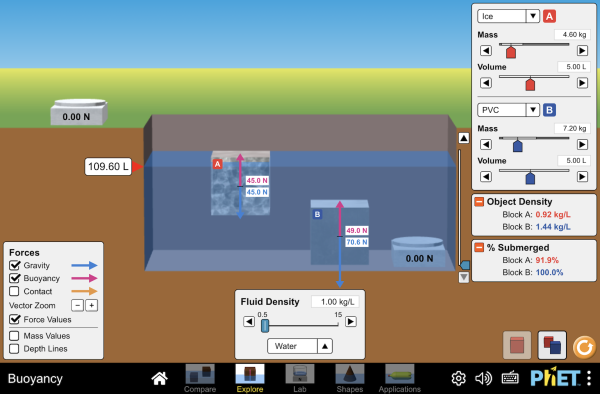
PhET: Buoyancy
When will objects float, and when will they sink? Learn how buoyancy works and the forces involved by experimenting with objects, like blocks, materials with different shapes, a bottle with substances inside, and blocks in a boat, in a pool with a fluid that can be modified.

PhET: Blackbody Spectrum
How does the blackbody spectrum of the sun compare to visible light? Learn about the blackbody spectrum of Sirius A, the sun, a light bulb, and the earth. Adjust the temperature to see the wavelength and intensity of the spectrum change. View the color of the peak of the spectral curve.
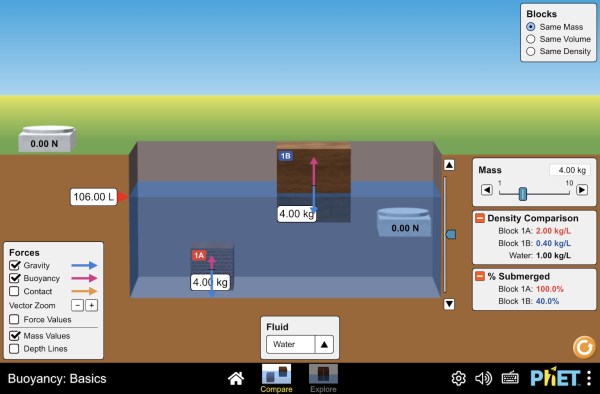
PhET: Buoyancy: Basics
When will objects float, and when will they sink? Learn how buoyancy works by experimenting with different blocks, modifying their volume and mass, and placing them in the pool with fluids of different densities. Analyze the forces generated when the block is inside the pool, and identify the variables that affect the buoyant force.
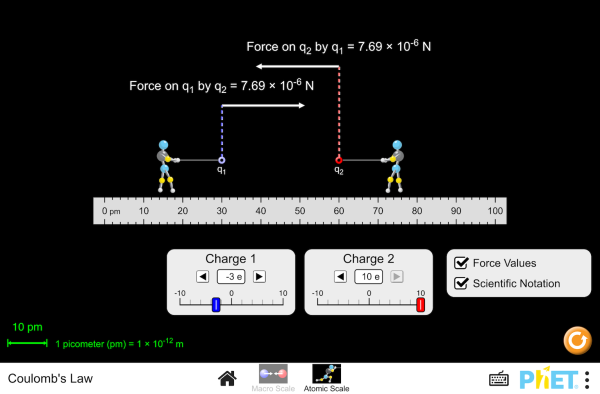
PhET: Coulomb's Law
Visualize the electrostatic force that two charges exert on each other. Observe how changing the sign and magnitude of the charges and the distance between them affects the electrostatic force.
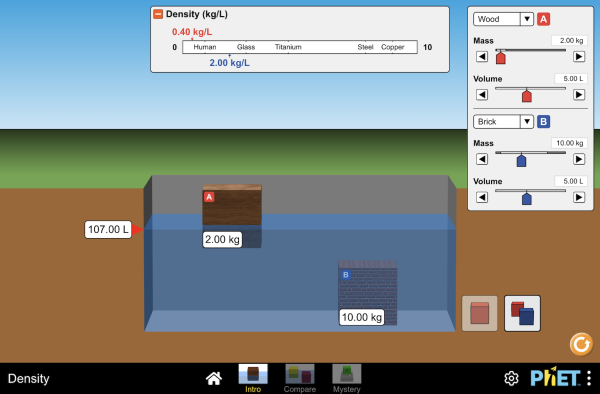
PhET: Density
Why do some materials like wood float in water, and others don’t? Interact with blocks of different materials, including a custom option by modifying their mass and volume, to explore the effect on the density and discover the conditions for sinking or floating in water. Play detective to determine the material of each block by comparing its density with the values in the table.
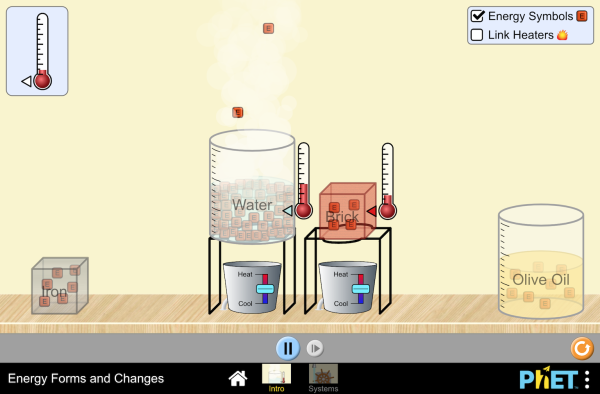
PhET: Energy Forms and Changes
Explore how heating and cooling iron, brick, water, and olive oil adds or removes energy. See how energy is transferred between objects. Build your own system, with energy sources, changers, and users. Track and visualize how energy flows and changes through your system.
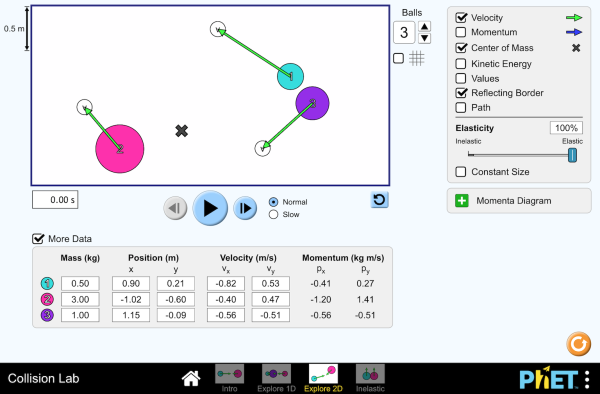
PhET: Collision Lab
Investigate simple collisions in 1D and more complex collisions in 2D. Experiment with the number of balls, masses, and initial conditions. Vary the elasticity and see how the total momentum and kinetic energy change during collisions.
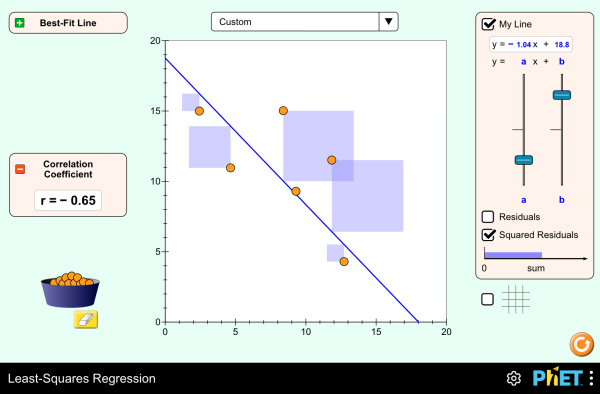
PhET: Least-Squares Regression
Create your own scatter plot or use real-world data and try to fit a line to it! Explore how individual data points affect the correlation coefficient and best-fit line.