frequency
Resources
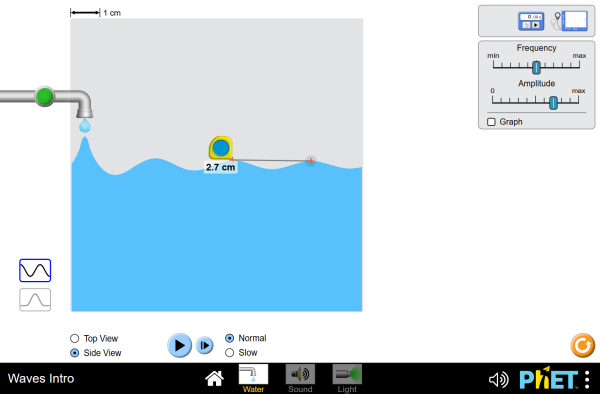
PhET: Waves Intro
Make waves with a dripping faucet, audio speaker, or laser! Adjust frequency and amplitude, and observe the effects. Hear the sound produced by the speaker, and discover what determines the color of light.
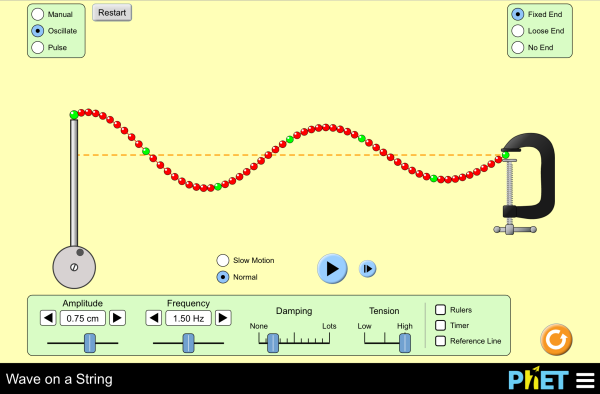
PhET: Wave on a String
Explore the wonderful world of waves! Even observe a string vibrate in slow motion. Wiggle the end of the string and make waves, or adjust the frequency and amplitude of an oscillator.

PhET: Sound Waves
This simulation lets you see sound waves. Adjust the frequency or volume and you can see and hear how the wave changes. Move the listener around and hear what she hears.
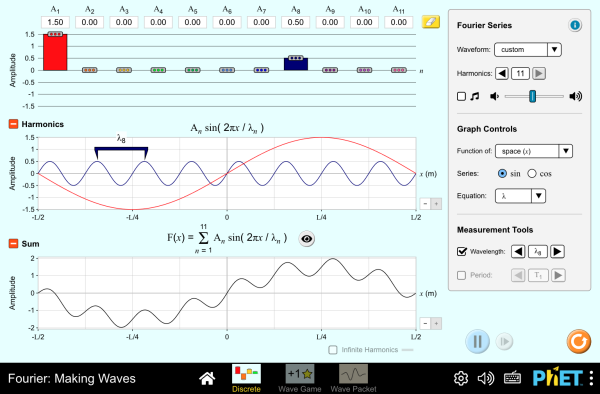
PhET: Fourier: Making Waves
Add up sines or cosines to make waves of different shapes. Discover how changing the amplitudes of different harmonics changes the sound you hear. Play the Wave Game and combine harmonics to match a target waveform. Construct wave packets and explore the effects of changing the spacing between Fourier components and wave packet width.
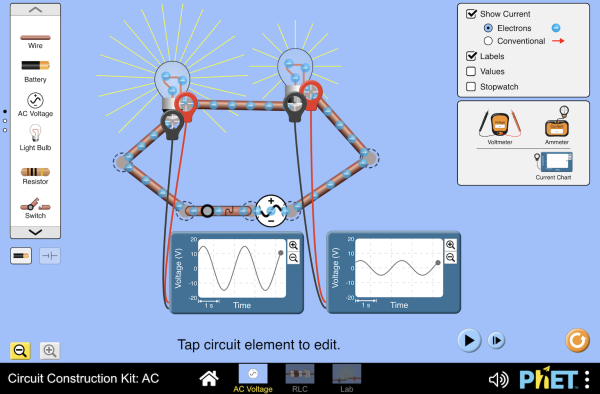
PhET: Circuit Construction Kit: AC
Experiment with an electronics kit! Build circuits with batteries, resistors, ideal and non-Ohmic light bulbs, fuses, and switches. Build circuits with AC voltage sources, batteries, resistors, capacitors, inductors, fuses, and switches. Take measurements with a lifelike ammeter and voltmeter and graph the current and voltage as a function of time. View the circuit as a schematic diagram or switch to a lifelike view.
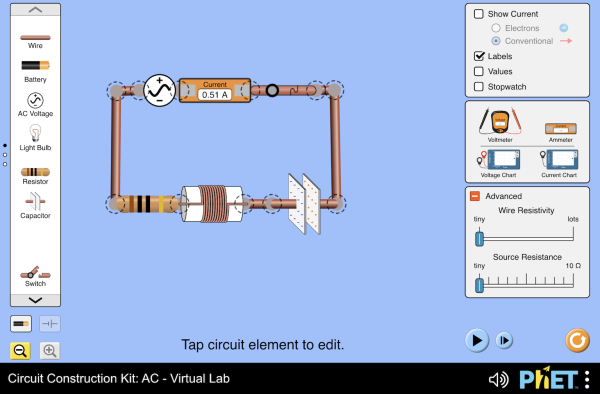
PhET: Circuit Construction Kit: AC - Virtual Lab
Do you like Circuit Construction Kit: AC, but want to use only in-line ammeters? This is the sim for you! Experiment with an electronics kit. Build circuits with AC voltage sources, batteries, resistors, capacitors, inductors, fuses, and switches. Take measurements with a lifelike ammeter and voltmeter and graph the current and voltage as a function of time. View the circuit as a schematic diagram or switch to a lifelike view.