Discover Resources
Browse curated homeschool resources from the community

The Pangaea Pop Up Michael Molina
The supercontinent Pangaea, with its connected South America and Africa, broke apart 200 million years ago. But the continents haven't stopped shifting -- the tectonic plates beneath our feet (in Earth's two top layers, the lithosphere and the asthenosphere) are still traveling at about the rate your fingernails grow. Michael Molina discusses the catalysts and consequences of continental drift.
Marcus Du Sautoy Symmetry Reality s Riddle
The world turns on symmetry -- from the spin of subatomic particles to the dizzying beauty of an arabesque. But there's more to it than meets the eye. Here, Oxford mathematician Marcus du Sautoy offers a glimpse of the invisible numbers that marry all symmetrical objects. Oxford's newest science ambassador Marcus du Sautoy is also author of The Times' Sexy Maths column. He'll take you footballing with prime numbers, whopping symmetry groups, higher dimensions and other brow-furrowers.

Daniel Dulek How Big is a Mole Not the Animal the Other One
The word “mole” suggests a small, furry burrowing animal to many. But in this lesson, we look at the concept of the mole in chemistry. Learn the incredible magnitude of the mole— and how something so big can help us calculate the tiniest particles in the world.

Joshua Manley Newton s 3 Laws with a Bicycle
Why would it be hard to pedal a 10,000 pound bicycle? This simple explanation shows how Newton’s 3 laws of motion help you ride your bike.
Brian Gervase Why the Shape of Your Screen Matters
Watching a movie at home isn’t quite the same experience as seeing it at a movie theater -- but why? Learn how changes in aspect ratio affect every film, and why your television might not be delivering the whole picture.

Epic Engineering Building the Brooklyn Bridge Alex Gendler
In the mid-19th century, suspension bridges were collapsing all across Europe. Their industrial cables frayed and snapped under the weight of their decks. So when German American engineer John Roebling proposed building the largest and most expensive suspension bridge ever conceived, New York City officials were understandably skeptical. Alex Gendler details the building of the iconic Brooklyn Bridge.

How Vampire Bats Drink Your Blood Without You Noticing Imran Razik
Vampire bats are the only mammals to subsist on blood alone. Their ancient ancestors might have eaten parasites and insects off larger animals until vampire bats began feeding directly from those animals themselves. So, how do these nocturnal creatures find their sustenance? And what animals do they most commonly target? Imran Razik follows the nighttime routine of a vampire bat as she hunts.

An Anti Hero of One s Own Tim Adams
How can an antihero teach us about the heroic--and sometimes, the unheroic--characteristics that shape a story’s protagonist? From jealousy to self-doubt, Tim Adams challenges us to consider how antiheroes reflect the very mortal weaknesses that can be found within all of us.

Could a Saturn Moon Harbor Life Carolyn Porco
Carolyn Porco shares exciting new findings from the Cassini spacecraft's recent sweep of one of Saturn's moons, Enceladus. Samples gathered from the moon's icy geysers hint that an ocean under its surface could harbor life.

Deep Ocean Mysteries and Wonders
In the deepest, darkest parts of the oceans are ecosystems with more diversity than a tropical rainforest. Taking us on a voyage into the ocean -- from the deepest trenches to the remains of the Titanic -- marine biologist David Gallo explores the wonder and beauty of marine life.
The Infinite Life of Pi Reynaldo Lopes
The ratio of a circle's circumference to its diameter is always the same: 3.14159... and on and on (literally!) forever. This irrational number, pi, has an infinite number of digits, so we'll never figure out its exact value no matter how close we seem to get. Reynaldo Lopes explains pi's vast applications to the study of music, financial models, and even the density of the universe.
How Curiosity Got Us to Mars Bobak Ferdowsi
In August 2012, the Curiosity rover landed on Mars. The landing itself was a huge achievement and required a lot of forethought and planning by a very smart team. In this TED Youth 2012 Talk, Bobak Ferdowsi, the mohawked member of that team, outlines various aspects of a Mars landing, including the Seven Minutes of Terror.
Nina Jablonski Breaks the Illusion of Skin Color
Nina Jablonski says that differing skin colors are simply our bodies' adaptation to varied climates and levels of UV exposure. Charles Darwin disagreed with this theory, however, as Jablonski explains, Darwin did not have access to NASA. Nina Jablonski is author of Skin: A Natural History, a close look at human skin's many remarkable traits: its colors, its sweatiness, the fact that we decorate it.

Can We Eat to Starve Cancer William Li
William Li presents a new way to think about treating cancer and other diseases: anti-angiogenesis, preventing the growth of blood vessels that feed a tumor. The crucial first (and best) step: Eating cancer-fighting foods that cut off the supply lines and beat cancer at its own game.

Light Waves Visible and Invisible Lucianne Walkowicz
Each kind of light has a unique wavelength, but human eyes can only perceive a tiny slice of the full spectrum -- the very narrow range from red to violet. Microwaves, radio waves, x-rays and more are hiding, invisible, just beyond our perception. Here is a closer look at the waves we can’t see.

Why is Nasa Sending a Spacecraft to a Metal World Linda T Elkins Tanton
In 2026, an unmanned NASA spacecraft is scheduled to arrive at 16 Psyche, a massive, metallic asteroid floating somewhere between the orbits of Mars and Jupiter. Why is NASA so interested in this heavy metal asteroid? Are we going to mine all that metal, or build a giant space magnet? Linda T. Elkins-Tanton explains how the real answer can be found right under our feet.
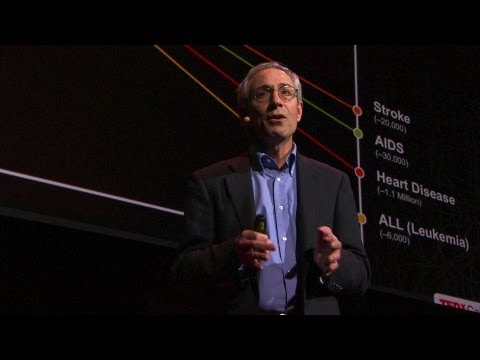
Toward a New Understanding of Mental Illness Thomas Insel
Today, thanks to better early detection, there are 63% fewer deaths from heart disease than there were just a few decades ago. Thomas Insel, Director of the National Institute of Mental Health, wonders: Could we do the same for depression and schizophrenia? The first step in this new avenue of research, he says, is a crucial reframing. (Filmed at TEDxCaltech.)

If Superpowers Were Real Immortality Joy Lin
What if immortality wasn't just the stuff of epic comic book stories? Is it scientifically possible to be immortal? In this series, Joy Lin tackles six superpowers and reveals just how scientifically realistic they can be to us mere mortals.

If Superpowers Were Real Invisibility Joy Lin
What if invisibility wasn't just the stuff of epic comic book stories? Is it scientifically possible to be invisible? In this series, Joy Lin tackles six superpowers and reveals just how scientifically realistic they can be to us mere mortals.
Kevin Slavin How Algorithms Shape Our World
Kevin Slavin argues that we're living in a world designed for -- and increasingly controlled by -- algorithms. In this riveting talk from TEDGlobal, he shows how these complex computer programs determine espionage tactics, stock prices, movie scripts, and architecture. Slavin also warns that we are writing code we can't understand with implications we can't control.