Discover Resources
Browse curated homeschool resources from the community
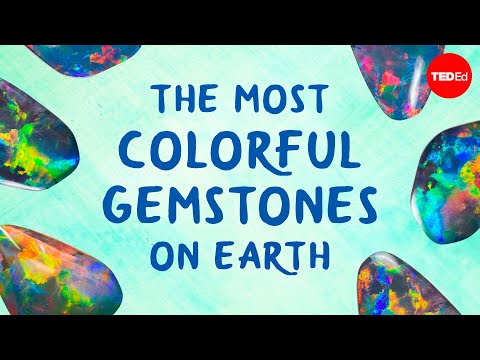
The Most Colorful Gemstones on Earth Jeff Dekofsky
In November 1986, Australian miners climbed Lunatic Hill and bored 20 meters into the Earth. They were rewarded with a fist-sized, record breaking gemstone, which they named the Hailey’s Comet opal. Thanks to a characteristic called “play of color,” no two opals look the same. So what causes these vibrant displays? Jeff Dekofsky digs into the rock’s shimmering, dancing displays of light.
Eye vs Camera Michael Mauser
Your eyes don’t always capture the world exactly as a video camera would. But the eyes are remarkably efficient organs, the result of hundreds of millions of years of coevolution with our brains. Michael Mauser outlines the similarities and differences between your eye and a video camera.

Could a Blind Eye Regenerate David Davila
We tend to think of blindness as something you're born with, but with certain genetic diseases, it can actually develop when you’re a kid, or even when you’re an adult. But could blind eyes possibly regenerate? David Davila explains how the zebrafish’s amazing regenerative retinas are causing scientists to investigate that very question.

Have We Reached the Limit of Computer Power Sajan Saini and George Zaidan
Moore’s Law states that every 1 to 2 years the number of transistors that can fit on a given size computer chip will double. Thanks to this law, chips have gotten smaller, faster, more efficient, and cheaper. But today, there are four key problems that trip up this trend, potentially ending Moore’s Law and fundamentally changing how computing progresses. Sajan Saini and George Zaidan investigate.

What Are Those Floaty Things in Your Eye Michael Mauser
Sometimes, against a uniform, bright background such as a clear sky or a blank computer screen, you might see things floating across your field of vision. What are these moving objects, and how are you seeing them? Michael Mauser explains the visual phenomenon that is floaters.

The Amazonian Myth of the Goblins Revenge Nathan D Horowitz
Deep in the Amazon rainforest in the river Nea’ocoyá lived a school of particularly big and tasty fish. When the rains came and the water rose the fish appeared, and swam away as the waters fell. Villagers along the river followed them to a lagoon and set up camp. But their young shaman soon sensed they might not be completely alone. Nathan D. Horowitz details the Siekopai myth of the air goblins.

The Merciless Mercenaries of the Italian Renaissance Stephanie Honchell Smith
During the 14th and 15th centuries, mercenaries known as condottieri dominated Italian warfare, profiting from— and encouraging— the region’s intense political rivalries. As rulers competed for power and prestige, their disputes often played out in military conflicts, fought almost entirely by the condottieri. So who were these elite and conniving warriors? Stephanie Honchell Smith investigates.

How to Design Climate Resilient Buildings Alyssa Amor Gibbons
Architecture can't ignore the realities of climate change. For time-tested solutions that perform under extreme conditions, designer Alyssa-Amor Gibbons says we should look to traditional buildings. Taking us to Barbados, where the hurricane season is unforgiving and storms are becoming more frequent, Gibbons points to the brilliance of endemic designs that are built to work with nature.
Can You Outsmart the Fallacy That Divided a Nation Elizabeth Cox
It’s 1819. The US is preparing to make Missouri and Maine new states. One representative insists that slavery shouldn’t be allowed in any new state. Another believes it should be a state’s right to choose. A compromise is proposed: slavery will be allowed in Missouri and prohibited in Maine. Can you spot the problem with this compromise? Elizabeth Cox explores the middle ground fallacy.
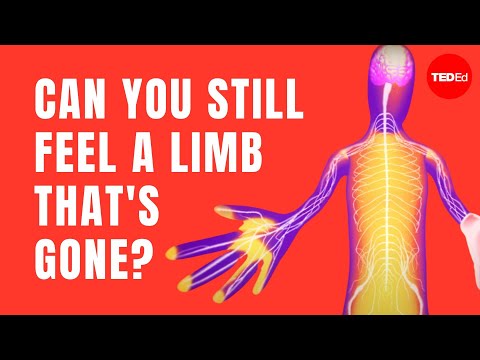
The Fascinating Science of Phantom Limbs Joshua W Pate
The vast majority of people who’ve lost a limb can still feel it — not as a memory or vague shape, but in complete lifelike detail. They can flex their phantom fingers and sometimes even feel the chafe of a watch band or the throb of an ingrown toenail. What causes these phantom limb sensations? Joshua W. Pate explains how the brain reacts to a missing limb.

The Case of the Vanishing Honeybees Emma Bryce
In the past decade, the US honeybee population has been decreasing at an alarming and unprecedented rate. While this is obviously bad news for honeypots everywhere, bees also help feed us in a bigger way -- by pollinating our nation's crops. Emma Bryce investigates potential causes for this widespread colony collapse disorder.

Are There Any Places on Earth with No Bugs Charles Wallace
Insects are the world’s most numerous and diverse animals. Even where you’d least expect them in some of Earth’s most extreme environments, there they are. From a scalding volcano, parched desert, to a frigid glacier, insects are living life on the edge. So, how do they do it? Charles Wallace illuminates the incredible survival skills of insects living in some of Earth's harshest ecosystems.

Inventing the American Presidency Kenneth C Davis
When the founders of the United States gathered to create the foundations of the country, they decided on three branches of government, with a president central to the executive branch. Kenneth C. Davis explains why this decision was not necessarily inevitable and what variables were up for debate.