Discover Resources
Browse curated homeschool resources from the community
Pool Medical Patents Save Lives Ellen T Hoen
Patenting a new drug helps finance its immense cost to develop -- but that same patent can put advanced treatments out of reach for sick people in developing nations, at deadly cost. Ellen 't Hoen talks about an elegant, working solution to the problem: the Medicines Patent Pool. (Filmed at TEDxZurich.)
From Mach 20 Glider to Humming Bird Drone Regina Dugan
"What would you attempt to do if you knew you could not fail?" asks Regina Dugan, then director of DARPA, the Defense Advanced Research Projects Agency. In this breathtaking talk she describes some of the extraordinary projects -- a robotic hummingbird, a prosthetic arm controlled by thought, and, well, the internet -- that her agency has created by not worrying that they might fail. (Followed by a Q&A with TED's Chris Anderson)

Is There a Center of the Universe Marjee Chmiel and Trevor Owens
It’s been a long road to the discovery that Earth is not the center of the Solar System, the Milky Way, or the universe; great thinkers from Aristotle to Bruno have grappled with it for millennia. But if we aren't at the center of the universe, what is? Marjee Chmiel and Trevor Owens discuss where we stand in the (very) big scheme of things.

Can You Outsmart This Logical Fallacy Alex Gendler
Meet Lucy. She was a math major in college, and aced all her courses in probability and statistics. Which do you think is more likely: that Lucy is a portrait artist, or that Lucy is a portrait artist who also plays poker? How do we know which statement is more likely to be true? Alex Gendler explores our tendency to look for shortcuts and the phenomenon known as the conjunction fallacy.

What is Zeno s Dichotomy Paradox Colm Kelleher
Can you ever travel from one place to another? Ancient Greek philosopher Zeno of Elea gave a convincing argument that all motion is impossible - but where's the flaw in his logic? Colm Kelleher illustrates how to resolve Zeno's Dichotomy Paradox.
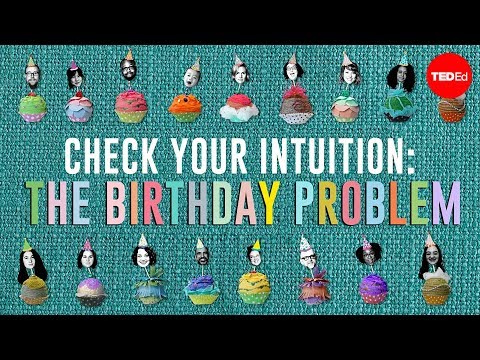
Check Your Intuition the Birthday Problem David Knuffke
Imagine a group of people. How big do you think the group would have to be before there’s more than a 50% chance that two people in the group have the same birthday? The answer is … probably lower than you think. David Knuffke explains how the birthday problem exposes our often-poor intuition when it comes to probability.
Early Forensics and Crime Solving Chemists Deborah Blum
In a CSI age, we take forensic science for granted. New York did not have a medical examiner or forensic toxicologist until 1918, whose eventual arrival changed the landscape of crime investigation forever. At TEDYouth 2012, Deborah Blum prompts the audience to solve crimes with chemistry.

String Theory and the Hidden Structures of the Universe Clifford Johnson
What is everything made of? Thus far, we can break everything in the universe down to a few very small elementary particles. But they fit into strange patterns that are not understood. Some scientists believe that this is because we can go deeper - perhaps to simple vibrating strings! At TEDYouth 2012, Clifford Johnson describes these ideas, along with the concept of string theory.

The Good and the Beautiful Language Arts Overview
The Good and the Beautiful is a Christian homeschool curriculum company offering Language Arts, Math, Science History, and elective courses.
History vs Andrew Jackson James Fester
Andrew Jackson was both beloved and loathed during his presidency. In this imaginary courtroom, you get to be the jury, considering and weighing Jackson’s part in the spoils system, economic depression, and the Indian Removal Act, as well as his patriotism and the pressures of the presidency. James Fester explores how time shapes our relationship to controversial historical figures.

Sylvia Earle s Ted Prize Wish to Protect Our Oceans
Legendary ocean researcher Sylvia Earle shares astonishing images of the ocean -- and shocking stats about its rapid decline -- as she makes her TED Prize wish: that we will join her in protecting the vital blue heart of the planet. Sylvia Earle has been at the frontier of deep ocean exploration for four decades. She's led more than 50 undersea expeditions, and she's been an equally tireless advocate for our oceans and the creatures who live in them.
Exploration on the Big Data Frontier Tim Smith
There is a mind-boggling amount of data floating around our society. Physicists at CERN have been pondering how to store and share their ever more massive data for decades - stimulating globalization of the internet along the way, whilst 'solving' their big data problem. Tim Smith plots CERN's involvement with big data from fifty years ago to today.
Mysteries of Vernacular Earwig Jessica Oreck and Rachael Teel
An earwig is neither an ear nor a wig; it is an insect. Jessica Oreck and Rachael Teel explain how folklore gave this bug its name, combining entomology with etymology.
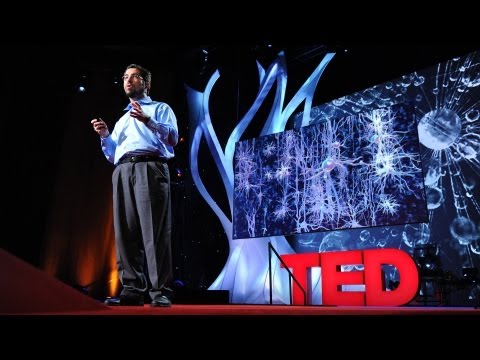
A Light Switch for Neurons Ed Boyden
Ed Boyden shows how, by inserting genes for light-sensitive proteins into brain cells, he can selectively activate or de-activate specific neurons with fiber-optic implants. With this unprecedented level of control, he's managed to cure mice of analogs of PTSD and certain forms of blindness. On the horizon: neural prosthetics. Session host Juan Enriquez leads a brief post-talk Q&A.

A Host of Heroes April Gudenrath
What can some of literature’s most famous heroes teach us? From the epic hero (like Beowulf) to the tragic hero (like Oedipus), each has something distinctive to share. April Gudenrath describes the many faces of the fictional hero -- and shows how they can inspire everyday people.

The True Story of True Gina Cooke
The older the word, the longer (and more fascinating) the story. With roots in Old English, 'true' shares etymological ancestors with words like betroth and truce...but also with the word tree. In fact, trees have been metaphors for steadfastness and faithfulness for as long as the word true has defined the same qualities. Gina Cooke describes the poetic relationship between 'tree' and 'true.'

The Dark History of Iq Tests Stefan C Dombrowski
In 1905, psychologists Alfred Binet and Théodore Simon designed a test for children who were struggling in school in France. Designed to determine which children required individualized attention, their method formed the basis of the modern IQ test. So how do IQ tests work, and are they a true reflection of intelligence? Stefan C. Dombrowski explores how the tests have been used throughout history.
Simply Good and Beautiful Math K (Free PDF)
Make learning math fun with this free homeschool math curriculum! Teach early math skills, multiplication facts, and everything in between!
Simply Good and Beautiful Math Overview
Simply Good and the Beautiful Math courses are fun and easy to teach! Choose your math level this hands-on spiral math curriculum.