Discover Resources
Browse curated homeschool resources from the community
Should We Get Rid of Standardized Testing Arlo Kempf
Although standardized testing is a particularly hot topic in education right now, this approach to measurement has been in use for two millennia. And while the results of standardized testing can help us understand some things, they can also be misleading if used incorrectly. So what do these tests actually measure? And are they worthwhile? Arlo Kempf investigates.

How Do Wind Turbines Work Rebecca J Barthelmie and Sara C Pryor
Every 24 hours, wind generates enough kinetic energy to produce roughly 35 times more electricity than humanity uses each day. And unlike coal or oil, this resource is totally renewed each day. So how can we harness this incredible amount of energy, and is it possible to create a world powered entirely by wind? Rebecca Barthelmie and Sara Pryor dig into the science of wind turbine technology.
The Largest River on Earth is Actually in the Sky Iseult Gillespie
The largest rainforest in the world, the Amazon, exists between two rivers — but not in the way you might think. At ground level, the Amazon River and its tributaries weave their path. But above the canopy, bigger waterways are on the move. These flying rivers are almost invisible, but are essential to life on Earth. Iseult Gillespie explores how this crucial system keeps the rainforest alive.
Can We Grow Human Brains Outside Our Bodies Madeline Lancaster
Shielded by our thick skulls and swaddled in layers of protective tissue, the human brain is extremely difficult to observe in action. Luckily, scientists can use brain organoids — pencil-eraser-sized masses of cells that function like human brains but aren’t part of an organism — to look closer. How do they do it? And is it ethical? Madeline Lancaster shares how to make a brain in a lab.

Why Did the British Empire Burn Sink and Hide These Documents Audra a Diptee
In 2009, five Kenyan people took a petition to the British Prime Minister. They claimed they endured human rights abuses in the 1950s, while Kenya was under British colonial rule, and demanded reparations. They had no documentary evidence that Britain sanctioned systems of torture— but thousands of secret files were waiting to be discovered. Audra Diptée digs into the Operation Legacy documents.
How Technology Can Fight Extremism and Online Harassment Yasmin Green
Can technology make people safer from threats like violent extremism, censorship and persecution? In this illuminating talk, technologist Yasmin Green details programs pioneered at Jigsaw (a unit within Alphabet Inc., the collection of companies that also includes Google) to counter radicalization and online harassment.

How to Make Your Writing Suspenseful Victoria Smith
What makes a good horror story? Hideous monsters and fountains of blood might seem like a good place to start, but as horror author H.P. Lovecraft wrote, “The oldest and strongest kind of fear is fear of the unknown.” Writers harness that fear not by revealing horrors, but by leaving the audience hanging in a state of suspense. Victoria Smith gives some tips for adding suspense to your writing.

Rosalind Franklin Dna s Unsung Hero Claudio L Guerra
The discovery of the structure of DNA was one of the most important scientific achievements in human history. The now-famous double helix is almost synonymous with Watson and Crick, two of the scientists who won the Nobel prize for figuring it out. But there’s another name you may not know: Rosalind Franklin. Cláudio L. Guerra shares the true story of the woman behind the helix.

How to Visualize One Part Per Million Kim Preshoff the Ted Ed Community
“Parts per million” is a scientific unit of measurement that counts the number of units of one substance per one million units of another. But because it’s hard to conceptualize really large numbers, it can be difficult to wrap our brains around what “one part per million” really means. Kim Preshoff (with help from 100+ animators from the TED-Ed Community) shares nine helpful ways to visualize it.
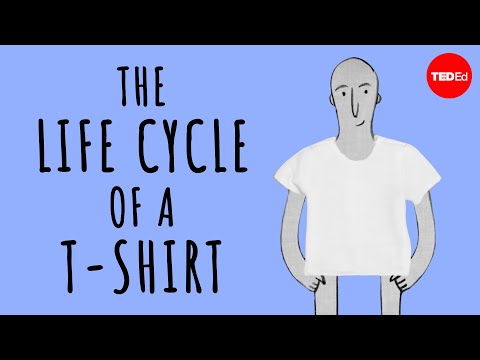
The Life Cycle of a T Shirt Angel Chang
Consider the classic white t-shirt. Annually, we sell and buy 2 billion t-shirts globally, making it one of the most common garments in the world. But how and where is the average t-shirt made, and what’s its environmental impact? Angel Chang traces the life cycle of a t-shirt.

How Much Electricity Does it Take to Power the World
All around the world, millions of people are flipping a switch, plugging in, and pressing an ‘on’ button every second. So how much electricity does humanity use? And how much will we need in the future? Discover how much energy it takes to power the world, and how clean energy sources could help revolutionize our electricity supply.
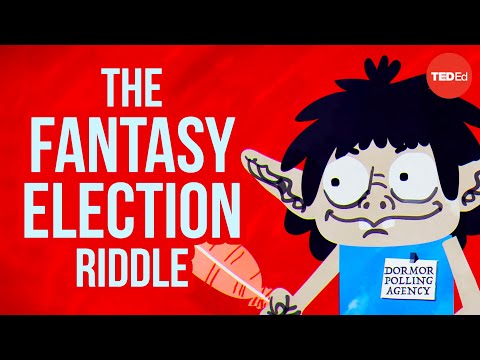
Can You Solve the Fantasy Election Riddle Dennis E Shasha
After much debate, the realm has decided dragon jousting may not be the best way to choose its leaders, and has begun transitioning to democracy. Your company was hired to survey the citizens of the land and predict which candidate will win. There’s a lot riding on this: if you get it wrong, heads— well, your head— will quite literally roll. Can you predict the winner? Dennis Shasha shows how.

Using Your Voice is a Political Choice Amanda Gorman
For anyone who believes poetry is stuffy or elitist, National Youth Poet Laureate Amanda Gorman has some characteristically well-chosen words. Poetry is for everyone and at its core it's all about connection and collaboration. In this fierce talk and performance, she explains why poetry is inherently political, pays homage to her honorary ancestors and stresses the value of speaking out.
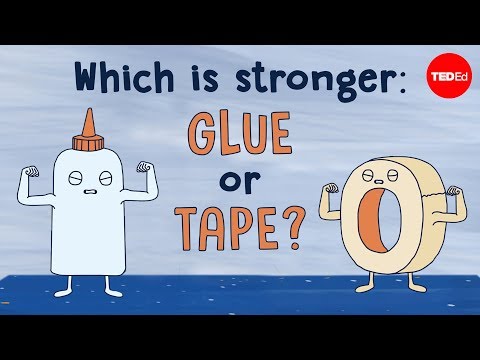
Which is Stronger Glue or Tape Elizabeth Cox
The oldest glue in the world is over 8,000 years old and comes from a cave near the Dead Sea. Today, we have enough types of tape and glue to build and repair almost anything. But what gives glue and tape their stickiness? And is one stronger than the other? Elizabeth Cox explores the world of adhesives.
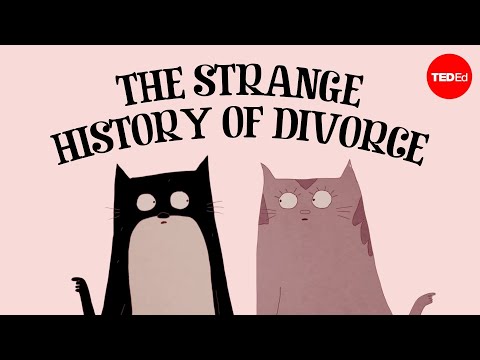
A Brief History of Divorce Rod Phillips
Formally or informally, human societies across place and time have made rules to bind and dissolve couples. The stakes of who can obtain a divorce, and why, have always been high. Divorce is a battlefield for some of society’s most urgent issues, including the roles of church and state, individual rights, and women’s rights. Rod Phillips digs into the complicated history of divorce.