HTML5
Resources
View all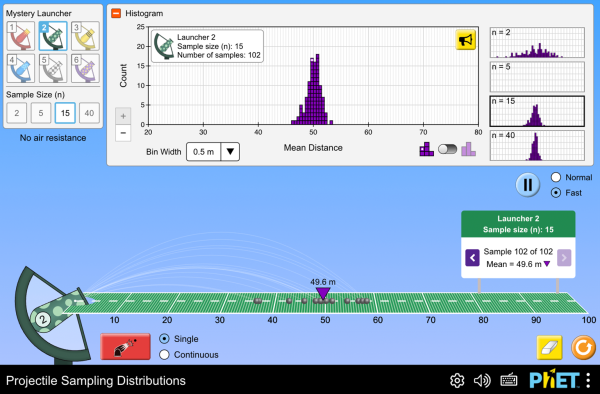
PhET: Projectile Sampling Distributions
Engage in hands-on data collection and analysis through the rich context of launching projectiles. Explore how different launch parameters create a variety of distributions as you watch the Central Limit Theorem come to life!
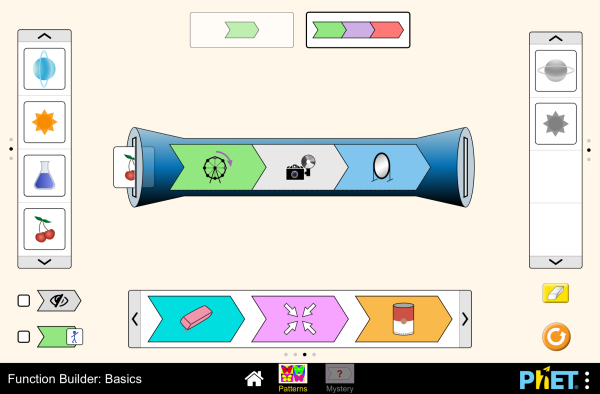
PhET: Function Builder: Basics
Play with functions while you ponder Art History. Look for patterns, then apply what you learned on the Mystery screen!
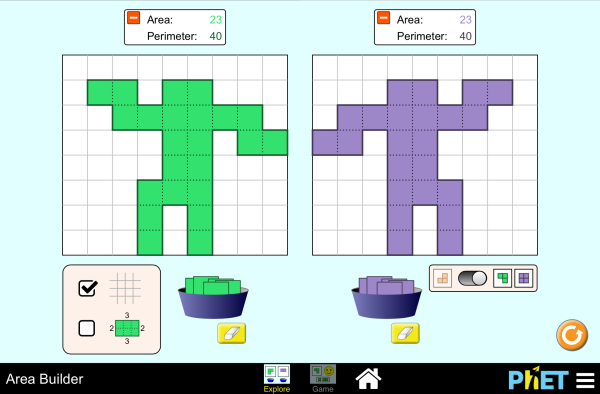
PhET: Area Builder
Create your own shapes using colorful blocks and explore the relationship between perimeter and area. Compare the area and perimeter of two shapes side-by-side. Challenge yourself in the game screen to build shapes or find the area of funky figures. Try to collect lots of stars!
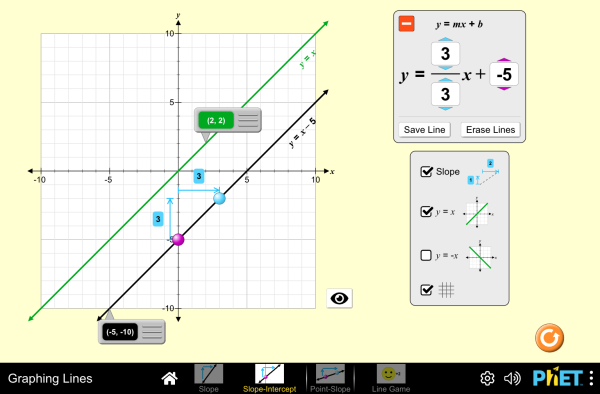
PhET: Graphing Lines
Explore the world of lines. Investigate the relationships between linear equations, slope, and graphs of lines. Challenge yourself in the line game!

PhET: Center and Variability
Center and Variability allows students to explore and compare measures of center and variability, including mean, median, range, IQR, and MAD.
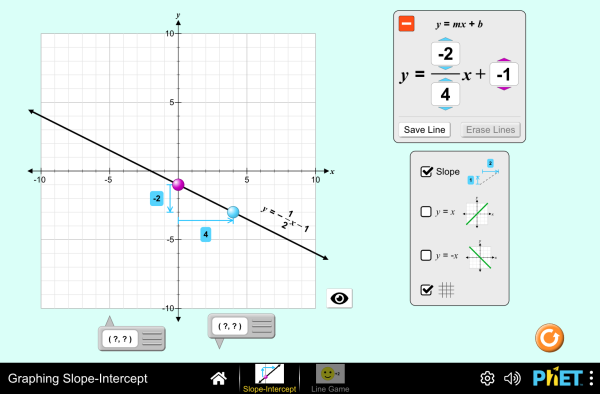
PhET: Graphing Slope-Intercept
Explore slope-intercept form of a line. Connect the slope and y-intercept to the equation of the line. Challenge yourself in the line game!
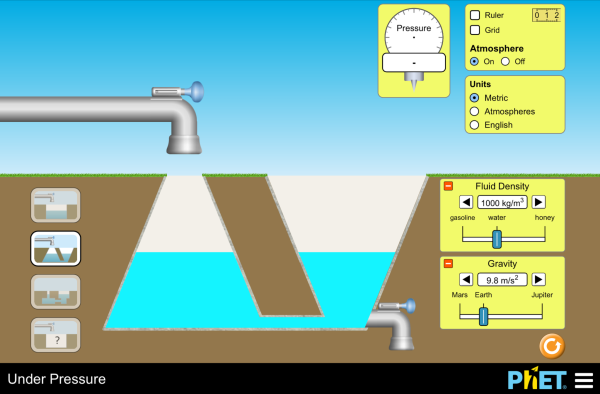
PhET: Under Pressure
Explore pressure under and above water. See how pressure changes as you change fluids, gravity, container shapes, and volume.
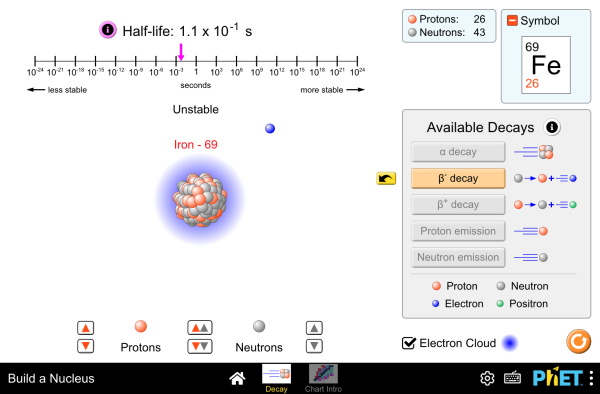
PhET: Build a Nucleus
How does changing the number of neutrons or protons affect the nuclear species, the stability of a nucleus, and its possible decay mechanisms? Explore different species, and learn about the common decay paths! Visualize these through the chart of the nuclides and discover the inner energy levels of the nucleus.
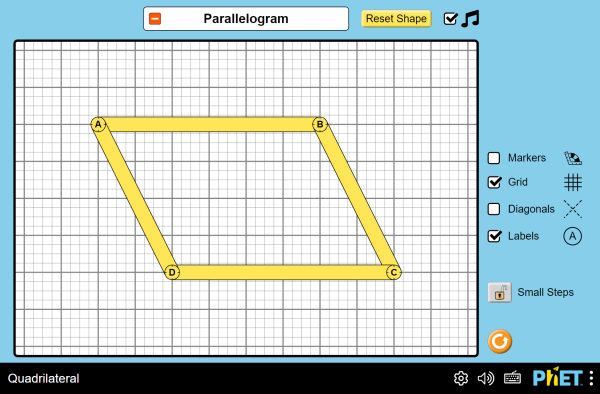
PhET: Quadrilateral
Explore the properties of and relationships between named four-sided shapes by moving sides and corners of a quadrilateral.
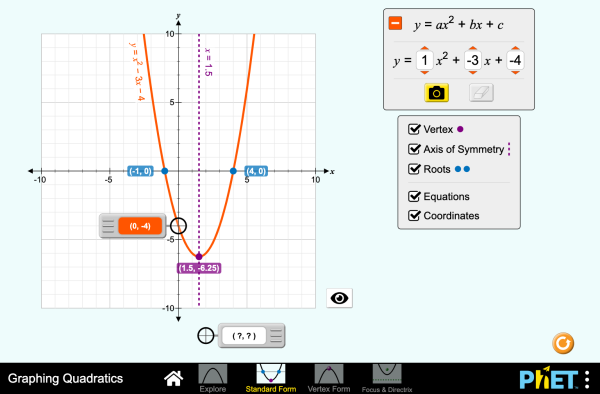
PhET: Graphing Quadratics
Discover how changing coefficients changes the shape of a curve. View the graphs of individual terms (e.g. y=bx) to see how they add to generate the polynomial curve. Generate definitions for vertex, roots, and axis of symmetry. Compare different forms of a quadratic function. Define a curve by its focus and directrix.
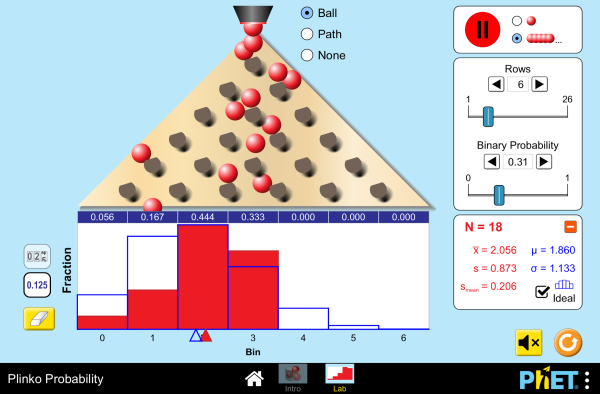
PhET: Plinko Probability
Drop balls through a triangular grid of pegs and see them accumulate in containers. Switch to a histogram view and compare the distribution of balls to an ideal binomial distribution. Adjust the binary probability and develop your knowledge of statistics!
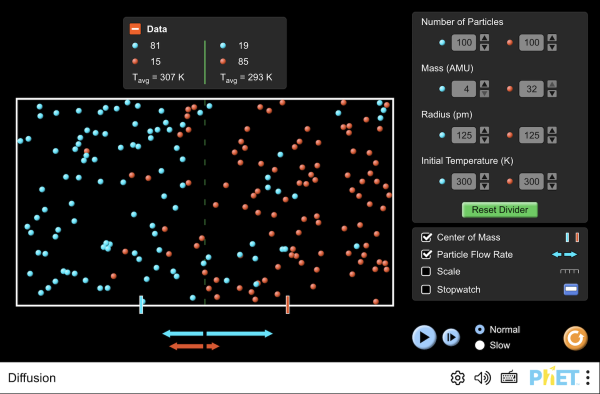
PhET: Diffusion
Mix two gases to explore diffusion! Experiment with concentration, temperature, mass, and radius and determine how these factors affect the rate of diffusion.
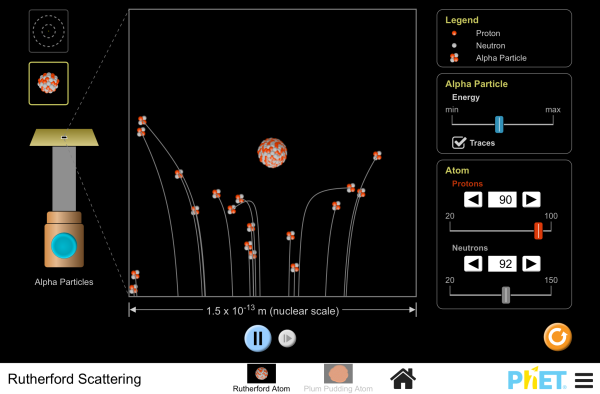
PhET: Rutherford Scattering
How did Rutherford figure out the structure of the atom without being able to see it? Simulate the famous experiment in which he disproved the Plum Pudding model of the atom by observing alpha particles bouncing off atoms and determining that they must have a small core.
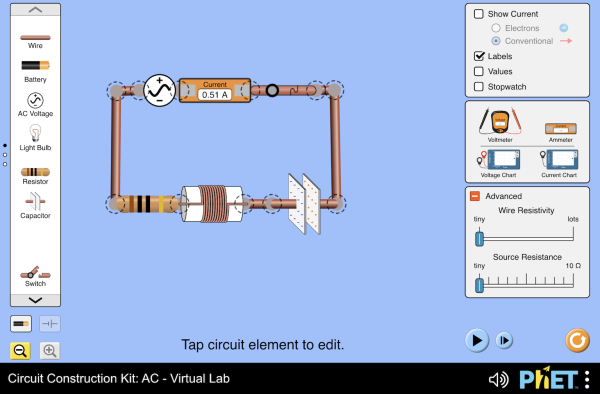
PhET: Circuit Construction Kit: AC - Virtual Lab
Do you like Circuit Construction Kit: AC, but want to use only in-line ammeters? This is the sim for you! Experiment with an electronics kit. Build circuits with AC voltage sources, batteries, resistors, capacitors, inductors, fuses, and switches. Take measurements with a lifelike ammeter and voltmeter and graph the current and voltage as a function of time. View the circuit as a schematic diagram or switch to a lifelike view.
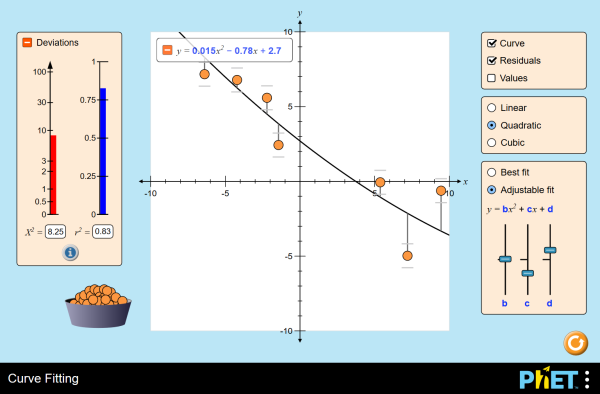
PhET: Curve Fitting
Drag data points and their error bars and watch the best-fit polynomial curve update instantly. You choose the type of fit: linear, quadratic, or cubic. The reduced chi-square statistic shows you when the fit is good. Or you can try to find the best fit by manually adjusting fit parameters.