Discover Resources
Browse curated homeschool resources from the community

The Good and the Beautiful Safety
The full-color course book guides the parent through each lesson in the Safety science course. Hands-on activities, vocabulary words, engaging information, access to captivating videos, mini books, beautiful illustrations and images, and more are found throughout the course. Once you gather any simple lesson supplies,
How to Squeeze Electricity Out of Crystals Ashwini Bharathula
It might sound like science fiction, but if you press on a crystal of sugar, it will actually generate its own electricity. This simple crystal can act like a tiny power source because sugar happens to be piezoelectric. Ashwini Bharathula explains how piezoelectric materials turn mechanical stress, like pressure, sound waves and other vibrations into electricity, and vice versa.

Just How Small is an Atom
Just how small are atoms? And what's inside them? The answers turn out to be astounding, even for those who think they know. This fast-paced animation uses spectacular metaphors (imagine a blueberry the size of a football stadium!) to give a visceral sense of the building blocks that make our world.

The Continents Are Moving When Will They Collide Jean Baptiste P Koehl
In the early 20th century, Alfred Wegener's theory of Continental Drift laid the foundation for our modern theory of plate tectonics. And today we know something even more exciting: Pangea was only the latest in a long lineage of supercontinents, and it won’t be the last. Jean-Baptiste P. Koehl explores when the next supercontinent will emerge — and what it might mean for Earth’s environment.

The World s Largest Organism Alex Rosenthal
The largest animal in the world is the blue whale, which weighs a massive 150 metric tons. Even so, it’s not remotely close to being the largest organism by weight. That title goes to an organism so huge that it’s estimated to weigh the equivalent of 40 blue whales. So what is this behemoth? And… where is it? Alex Rosenthal shares the story of the enormous and ancient Pando.

The Secret Signals Elephants Use to Communicate Chase Ladue and Bruce a Schulte
As a breeze blows through the savannah, a snake-shaped tube stretches into the air and scans the horizon like a periscope. But it’s not seeing— it’s sniffing. Containing no bones and an estimated 40,000 muscles, an elephant trunk is one of the most versatile tools in the animal kingdom. Chase LaDue and Bruce Schulte detail the incredible capabilities of these agile appendages.

The Sexual Deception of Orchids Anne Gaskett
Nearly 28,000 species of orchid grow all around the world, bearing every imaginable color, shape and pattern. There’s a cunning purpose behind these elaborate displays: many orchids trick insects into pollinating, sometimes even into having sex with them. How do they deploy these deceptive tactics? Anne Gaskett dives into the surprisingly complex ways orchids attract insects.

How Did the Milky Way Get its Shape Scott Hershberger
Thirteen billion years ago, the gas and dust particles that eventually became our Milky Way were whizzing around in every direction. Despite the wild motion of its parts, the galaxy as a whole was rotating about an axis. So why did the Milky Way, like most galaxies, become flat, and not spherical like stars and planets? Scott Hershberger explores the ever-evolving structure of our galaxy.

What Almost Dying Taught Me About Living Suleika Jaouad
"The hardest part of my cancer experience began once the cancer was gone," says author Suleika Jaouad. In this fierce, funny, wisdom-packed talk, she challenges us to think beyond the divide between "sick" and "well," asking: How do you begin again and find meaning after life is interrupted?

How Do Whales Sing Stephanie Sardelis
Communicating underwater is challenging. Light and odors don’t travel well, but sound moves about four times faster in water than in air — which means marine mammals often use sounds to communicate. The most famous of these underwater vocalizations is undoubtedly the whale song. Stephanie Sardelis decodes the evocative melodies composed by the world’s largest mammals.

What Earth in 2125 Could Look Like Iseult Gillespie
Faced with the realities of current crises, it’s easy to assume our world is headed in a bleak direction. But there’s good reason to be hopeful— with developments in science and technology, a positive future is more viable than ever before. So, what if the future was awesome? Iseult Gillespie explores what three cities could look like in 100 years if we harness the tools we have at our disposal.
Can a Black Hole Be Destroyed Fabio Pacucci
Black holes are among the most destructive objects in the universe. Anything that gets too close to a black hole, be it an asteroid, planet, or star, risks being torn apart by its extreme gravitational field. By some accounts, the universe may eventually consist entirely of black holes. But is there any way to destroy a black hole? Fabio Pacucci digs into the possibility.

How Tsunamis Work Alex Gendler
The immense swell of a tsunami can grow up to 100 feet, hitting speeds over 500 mph -- a treacherous combination for anyone or anything in its path. Alex Gendler details the causes of these towering terrors and explains how scientists are seeking to reduce their destruction in the future.
Can You Solve the Alien Pyramid Riddle Henri Picciotto
Today is the anniversary of the best-worst day of your life. The best part was discovering a subterranean city on Mars. The worst part was when you lost contact with Earth. You and the other 99 scientists have spent the year engineering your survival, but you’re almost out of water and solutions. Can you figure out how the last civilization lived on this desert planet? Henri Picciotto shows how.
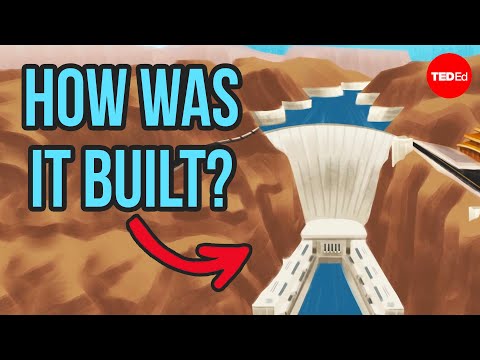
Blood Concrete and Dynamite Building the Hoover Dam Alex Gendler
In the early 20th century, the US had expanded from coast to coast, but many cities in the southwest still lacked reliable water sources. The Colorado River's erratic flow and frequent floods made it unreliable for agriculture, and the region’s growing cities needed more energy. So the government decided to build a massive hydroelectric dam. Alex Gendler details the creation of the Hoover Dam.