Discover Resources
Browse curated homeschool resources from the community

Joshua Manley Newton s 3 Laws with a Bicycle
Why would it be hard to pedal a 10,000 pound bicycle? This simple explanation shows how Newton’s 3 laws of motion help you ride your bike.

Why the Octopus Brain is so Extraordinary Claudio L Guerra
Octopuses have the ability to solve puzzles, learn through observation, and even use tools – just like humans. But what makes octopus intelligence so amazing is that it comes from a biological structure completely different from ours. Cláudio L. Guerra takes a look inside the amazing octopus brain.

Getting Started as a Dj Mixing Mashups and Digital Turntables Cole Plante
DJ and producer Cole Plante is only 17 years old, but he's already worked alongside industry superstars Skrillex, Avicii and Major Lazer (to name just a few). In this combination talk and DJ set, Plante shows off his mixing magic and gives tips to aspiring DJs.

The Counterintuitive Way to Be More Persuasive Niro Sivanathan
What's the best way to make a good point? Organizational psychologist Niro Sivanathan offers a fascinating lesson on the "dilution effect," a cognitive quirk that weakens our strongest cases — and reveals why brevity is the true soul of persuasion.
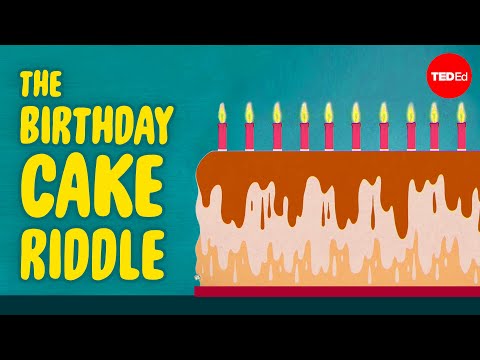
Can You Solve the Birthday Cake Riddle Marie Brodsky
Your friend’s birthday is tomorrow, and he’s turning… well… you’ve forgotten. A ginormous cake has been prepared and your job is to sculpt his age as the chocolate centerpiece. The birthday boy is a giant, and you’re afraid that if your forgetfulness becomes known, you’ll become part of the feast. Can you figure out your friend’s age before the party? Marie Brodsky shows how.

Noreena Hertz How to Use Experts and When Not to
We make important decisions every day -- and we often rely on experts to help us decide. But, says economist Noreena Hertz, relying too much on experts can be limiting and even dangerous. She calls for us to start democratizing expertise -- to listen not only to "surgeons and CEOs, but also to shop staff."

The Good and the Beautiful Science Overview
The Good and the Beautiful is a Christian homeschool curriculum company offering Language Arts, Math, Science History, and elective courses.

The Weird Things Thatd Happen If We Blew Up This Mountain Elise Cutts
Mount Teide is one of the world’s largest active volcanoes, and there may be a way to use the basalt rock inside it to save humanity. Obviously, destroying an ancient volcano would cause catastrophic and unpredictable ecological fallout. But what if we harvested only some of that basalt— could it really stop climate change? Elise Cutts explores the fascinating science of enhanced rock weathering.

The Fundamentals of Space Time Part 3 Andrew Pontzen and Tom Whyntie
In the first two lessons of this series on space-time, we've dealt with objects moving at constant speeds, with straight world lines, in space-time. But what happens when you throw gravity into the mix? In this third and final lesson, CERN scientists Andrew Pontzen and Tom Whyntie explore what gravity means for space-time -- or rather, what space-time means for gravity.
The Battle That Formed the Universe Fabio Pacucci
It’s time for the biggest battle in the Universe: the Big Bang. In one corner is gravity— the force that brings all matter together. In the other is pressure— the force that can push matter away. Over the next several hundred thousand years, these two contenders will be wrestling for the fate of the Universe. But what are these powers fighting over? Fabio Pacucci digs into this historic matchup.

The Case of the Vanishing Honeybees Emma Bryce
In the past decade, the US honeybee population has been decreasing at an alarming and unprecedented rate. While this is obviously bad news for honeypots everywhere, bees also help feed us in a bigger way -- by pollinating our nation's crops. Emma Bryce investigates potential causes for this widespread colony collapse disorder.

Football Physics Scalars and Vectors Michelle Buchanan
An unbelievable play on an American football field is the perfect backdrop for understanding crucial physics concepts. Michelle Buchanan goes play-by-play on the vectors, the scalars, and the glory of a downright scientific touchdown.

From the Top of the Food Chain Down Rewilding Our World George Monbiot
Our planet was once populated by megafauna, big top-of-the-food-chain predators that played their part in balancing our ecosystems. When those megafauna disappear, the result is a "trophic cascade," where every part of the ecosystem reacts to the loss. How can we stay in balance? George Monbiot suggests rewilding: putting wolves, lions and other predators back on top -- with surprising results.
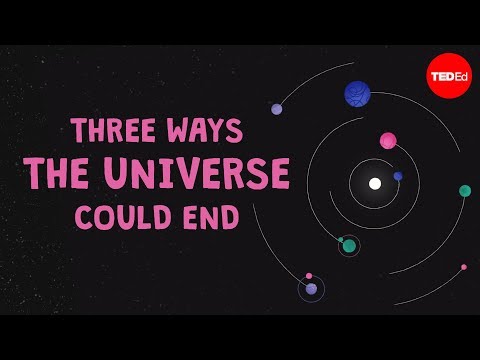
Three Ways the Universe Could End Venus Keus
We know about our universe’s past: the Big Bang theory predicts that all matter, time and space began about 14 billion years ago. And we know about the present: scientists’ observations of galaxies tell us that the universe is expanding at an accelerated rate. But what about the future? Do we know how our universe is going to end? Venus Keus explores cosmologists’ three possible scenarios.

The Fascinating History of Cemeteries Keith Eggener
Spindly trees, rusted gates, crumbling stone, a solitary mourner: these things come to mind when we think of cemeteries. But not long ago, many burial grounds were lively places, with gardens and crowds of people -- and for much of human history, we didn’t bury our dead at all. How did cemeteries become what they are today? Keith Eggener delves into our ever-evolving rituals for honoring the dead.

Mysteries of Vernacular X Ray Jessica Oreck and Rachael Teel
The story of the word X-Ray is one of great thinkers. French philosopher Rene Descartes isolated the letters X, Y and Z to stand for unknowns, and centuries later, Wilhelm Röntgen discovered the X-ray, using the X for the unknown nature of the radiation. Jessica Oreck and Rachael Teel shed some light on the etymology of this modern marvel.
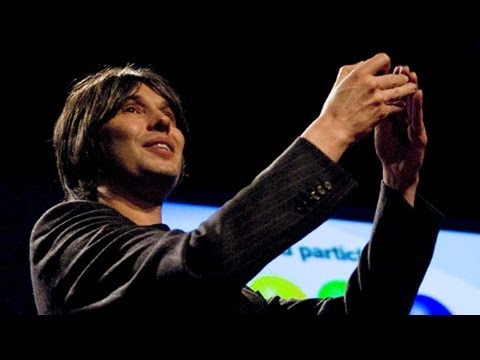
Brian Cox on Cern s Supercollider
"Rock-star physicist" Brian Cox talks about his work on the Large Hadron Collider at CERN. Discussing the biggest of big science in an engaging and accessible way, Cox brings us along on a tour of the massive project.
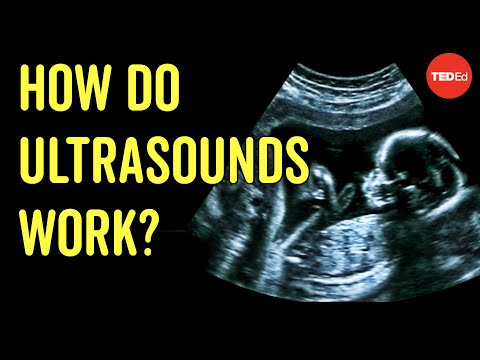
How Does Ultrasound Work Jacques s Abramowicz
In a dark cave, bats can’t see much. But even with their eyes shut, they can navigate rocky topography at incredible speeds. This is because bats aren't just guided by their eyes, but rather, by their ears. It may seem impossible to see with sound, but bats, naval officers, and doctors do it all the time. How is that possible? Jacques S. Abramowicz digs into the unique properties of ultrasound.