Discover Resources
Browse curated homeschool resources from the community

Mysteries of Vernacular Lady Jessica Oreck and Rachael Teel
Why do we call women ladies? Well, etymologically-speaking, the word comes from the Old English words for hlaf (bread) and daege (maid), which, combined, mean the female head of the household and eventually indicated high social standing. Jessica Oreck and Rachael Teel follow the word to its contemporary position simply describing a female.


How Antibiotics Become Resistant Over Time Kevin Wu
Right now, you are inhabited by trillions of microorganisms. Many of these bacteria are harmless (or even helpful!), but there are a few strains of ‘super bacteria’ that are pretty nasty -- and they’re growing resistant to our antibiotics. Why is this happening? Kevin Wu details the evolution of this problem that presents a big challenge for the future of medicine.

Exploring Other Dimensions Alex Rosenthal and George Zaidan
Imagine a two-dimensional world -- you, your friends, everything is 2D. In his 1884 novella, Edwin Abbott invented this world and called it Flatland. Alex Rosenthal and George Zaidan take the premise of Flatland one dimension further, imploring us to consider how we would see dimensions different from our own and why the exploration just may be worth it.

What s Happening to Earth s Core Shannon Odell
A hydrogen atom is traveling high within the outermost layer of Earth’s atmosphere. This particular atom first entered the exosphere millions of years ago, but today it overcomes Earth’s gravitational pull and escapes, joining the roughly 90 tons of material that leak out of our atmosphere each day. Should we be worried about these leaks? Shannon Odell digs into our planet’s imperfect plumbing.

Sunlight is Way Older Than You Think Sten Odenwald
It takes light a zippy 8 minutes to reach Earth from the surface of the Sun. But how long does it take that same light to travel from the Sun’s core to its surface? Oddly enough, the answer is many thousands of years. Sten Odenwald explains why by illustrating the random walk problem.

How Far Would You Have to Go to Escape Gravity Rene Laufer
Every star, black hole, human being, smartphone and atom are all constantly pulling on each other due to one force: gravity. So why don’t we feel pulled in billions of different directions? And is there anywhere in the universe where we'd be free of its pull? Rene Laufer details the inescapability of gravity.
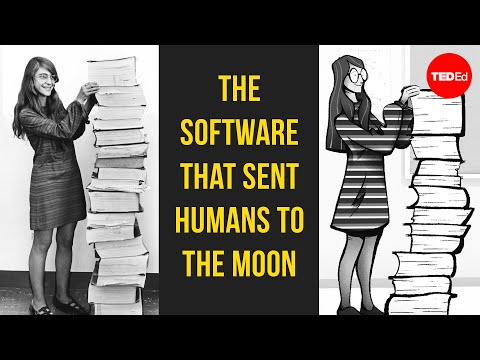
The Software That Sent Humans to the Moon Matt Porter and Margaret Hamilton
The Apollo 11 moon landing was about the astronauts, mission control, software and hardware all working together as a seamless integrated system. None of which would have been possible without the contributions of one engineer: Margaret Hamilton. Who was this pioneer? Matt Porter and Margaret Hamilton detail how a woman and her team launched the software that took mankind to the Moon.
Can You Solve the Time Traveling Car Riddle Dan Finkel
You and the professor have driven your DeLorean back to the past to fix issues with the spacetime continuum caused by your time traveling. But another DeLorean appears with older versions of you and the professor. The professors panic and explain that the universe could collapse now that you’re both in the same time and place. Can you merge the timestreams and travel home? Dan Finkel shows how.

What is the Shape of a Molecule George Zaidan and Charles Morton
A molecule is nearly all empty space, apart from the extremely dense nuclei of its atoms and the clouds of electrons that bond them together. When that molecule forms, it arranges itself to maximize attraction of opposite charges and minimize repulsion of unlike. George Zaidan and Charles Morton shape our image of molecules.

How to Visualize One Part Per Million Kim Preshoff the Ted Ed Community
“Parts per million” is a scientific unit of measurement that counts the number of units of one substance per one million units of another. But because it’s hard to conceptualize really large numbers, it can be difficult to wrap our brains around what “one part per million” really means. Kim Preshoff (with help from 100+ animators from the TED-Ed Community) shares nine helpful ways to visualize it.

Why Do Competitors Open Their Stores Next to One Another Jac De Haan
Why are all the gas stations, cafes and restaurants in one crowded spot? As two competitive cousins vie for ice-cream-selling domination on one small beach, discover how game theory and the Nash Equilibrium inform these retail hotspots.

How Labor Unions Shape Society Margaret Levi
The weekend. Social Security. Health insurance. What do these things have in common? They all exist thanks to the advocacy of labor unions. Political economist Margaret Levi explains how these organizations forge equality and protect worker rights, calling for a 21st-century revival of the labor movement in order to build a more equitable future.
What Makes Muscles Grow Jeffrey Siegel
We have over 600 muscles in our bodies that help bind us together, hold us up, and help us move. Your muscles also need your constant attention, because the way you treat them on a daily basis determines whether they will wither or grow. Jeffrey Siegel illustrates how a good mix of sleep, nutrition and exercise keep your muscles as big and strong as possible.

Mysteries of Vernacular Dynamite Jessica Oreck and Rachael Teel
With an explosive meaning, the word dynamite’s past is as historical as it is etymological. Jessica Oreck and Rachael Teel describe how Alfred Nobel invented dynamite.

How to Use Rhetoric to Get What You Want Camille a Langston
How do you get what you want, using just your words? Aristotle set out to answer exactly that question over two thousand years ago with a treatise on rhetoric. Camille A. Langston describes the fundamentals of deliberative rhetoric and shares some tips for appealing to an audience’s ethos, logos, and pathos in your next speech.

Why Did People Wear Powdered Wigs Stephanie Honchell Smith
Wigs date at least as far back as ancient Egypt, where well-regarded hairdressers crafted them into intricate styles. And under certain ancient Roman dynasties, women’s wigs became particularly ornate. Yet it wasn’t until Louis XIII unveiled a magnificent mane in the 17th century that big wigs truly began booming. Stephanie Honchell Smith details the rise and fall of the bewigged fashion craze.