Discover Resources
Browse curated homeschool resources from the community
The beginning of the universe, for beginners - Tom Whyntie
Learn about the Big Bang and the origins of everything.
TED-Ed: Is Light a Particle or a Wave?
Can we accurately describe light as exclusively a wave or just a particle? Are the two mutually exclusive? In this third part of his series on light and color, Colm Kelleher discusses wave-particle duality and its relationship to how we see light and, therefore, color.

TED-Ed: Can You Solve the Frog Riddle?
You’re stranded in a rainforest, and you’ve eaten a poisonous mushroom. To save your life, you need an antidote excreted by a certain species of frog. Unfortunately, only the female frog produces the antidote. The male and female look identical, but the male frog has a distinctive croak. Derek Abbott shows how to use conditional probability to make sure you lick the right frog and get out alive.

TED-Ed: The Carbon Cycle
What exactly is the carbon cycle? Nathaniel Manning provides a basic look into the cyclical relationship of carbon, humans and the environment.
TED-Ed: How Does a Particle Accelerator Work?
An atom smasher, or particle accelerator, collides atomic nuclei together at extremely high energies, using engineering that exploits incredibly cold temperatures, very low air pressure, and hyperbolically fast speeds. Don Lincoln explains how scientists harness the power of both electric and magnetic fields to smash atoms, eventually leading to major discoveries about the matter in our universe.
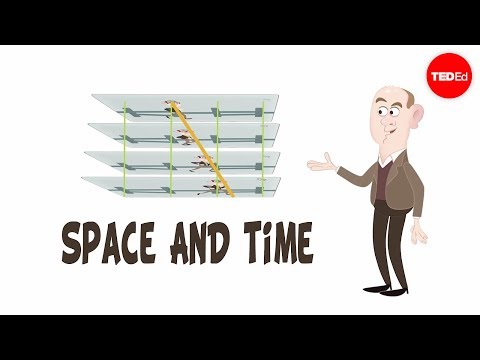
TED-Ed: The Fundamentals of Space-Time
Space is where things happen. Time is when things happen. And sometimes, in order to really look at the universe, you need to take those two concepts and mash them together. In this first lesson of a three-part series on space-time, hilarious hosts Andrew Pontzen and Tom Whyntie go through the basics of space and time individually, and use a flip book to illustrate how we can begin to look at them together.

Cell vs. virus: A battle for health - Shannon Stiles
Watch the epic battle between your cells and invading viruses.

TED-Ed: What Happens to Plastic You Throw Away?
We’ve all been told that we should recycle plastic bottles and containers. But what actually happens to the plastic if we just throw it away? Emma Bryce traces the life cycles of three different plastic bottles, shedding light on the dangers these disposables present to our world.

TED-Ed: What Is the Universe Made Of?
The atoms around you have existed for billions of years -- and most originated in the flaming, gaseous core of a star. Dennis Wildfogel tells the captivating tale of these atoms' long journeys from the Big Bang to the molecules they form today.
TED-Ed: How Do Your Kidneys Work?
After drinking a few glasses of water on a hot day, you might be struck with a sudden ... urge. Behind that feeling are two bean-shaped organs that work as fine-tuned internal sensors. Emma Bryce details how the incredible kidneys balance the amount of fluid in your body, detect waste in your blood, and know when to release the vitamins, minerals, and hormones you need to stay alive.

TED-Ed: What Triggers a Chemical Reaction?
Chemicals are in everything we see, and the reactions between them can look like anything from rust on a spoon to an explosion on your stovetop. But why do these reactions happen in the first place? Kareem Jarrah answers this question by examining the two underlying forces that drive both endothermic and exothermic chemical reactions: enthalpy and entropy.

TED-Ed: How Do We Study Living Brains?
As far as we know, there’s only one thing in our solar system sophisticated enough to study itself: the human brain. But this self-investigation is challenging because a living brain is shielded by skull, swaddled in tissue, and made up of billions of tiny cells. How do we study living brains without harming their owners? Elizabeth Waters and John Borghi explain how EEGs, fMRIs, and PETs work.

TED-Ed: How Do Your Hormones Work?
Over our lifetimes, our bodies undergo a series of extraordinary metamorphoses: we grow, experience puberty, and many of us reproduce. Behind the scenes, the endocrine system works constantly to orchestrate these changes. Emma Bryce explains how this system regulates everything from your sleep to the rhythm of your beating heart, exerting its influence over each and every one of your cells.
TED-Ed: How Your Muscular System Works
Each time you take a step, 200 muscles work in unison to lift your foot, propel it forward, and set it down. It’s just one of the many thousands of tasks performed by the muscular system: this network of over 650 muscles covers the body and is the reason we can blink, smile, run, jump, and stand upright. So how does it work? Emma Bryce takes you into the body to find out.

TED-Ed: The Genes You Don't Get from Your Parents
Inside our cells, each of us has a second set of genes completely separate from our 23 pairs of chromosomes. And this isn’t just true for humans— it’s true of every animal, plant, and fungus on Earth. This second genome belongs to our mitochondria, an organelle inside our cells. So why are they so different from anything else in our bodies? Devin Shuman explores the purpose of mitochondrial DNA.

TED-Ed: How the Stamp Act Divided a Nation
You may think that things are heated in Washington today, but the Kansas-Nebraska Act of 1854 had members of Congress so angry they pulled out their weapons -- and formed the Republican Party. The issues? Slavery and states' rights, which led the divided nation straight into the Civil War. Ben Labaree, Jr. explains how Abraham Lincoln's party emerged amidst the madness.
TED-Ed: How Does Caffeine Keep Us Awake?
Over 100,000 metric tons of caffeine are consumed around the world every year. That’s equivalent to the weight of 14 Eiffel Towers! Caffeine helps us feel alert, focused, and energetic, even if we haven’t had enough sleep — but it can also raise our blood pressure and make us feel anxious. So how does it keep us awake? Hanan Qasim shares the science behind the world’s most widely used drug.

TED-Ed: Is Perfectionism Just Procrastination in Disguise?
What separates struggling artists from successful ones? Looking to creative geniuses like Mozart, Edison and Monet, video creator Jon Youshaei explains why aiming to be prolific — despite flops and failures along the way — is the key to unlocking your creative success.

TED-Ed: Could We Actually Live on Mars?
There's a lot of talk these days about when and how we might all move to Mars. But what would it actually be like to live there? Mari Foroutan details the features of Mars that are remarkably similar to those of Earth — and those that can only be found on the red planet.

TED-Ed: How Food Affects Your Gut
The bacteria in our guts can break down food the body can’t digest, produce important nutrients, regulate the immune system, and protect against harmful germs. And while we can’t control all the factors that go into maintaining a healthy gut microbiome, we can manipulate the balance of our microbes by paying attention to what we eat. Shilpa Ravella shares the best foods for a healthy gut.

How stress affects your brain - Madhumita Murgia
The neuroscience of stress and its effects on your brain.