Discover Resources
Browse curated homeschool resources from the community

Why Animals Help Each Other Ashley Ward
Charles Darwin introduced the notion of “survival of the fittest,” where the fittest animals are those who can survive long enough to produce healthy offspring. The fittest animal can also be the most stealthy, resourceful, or even the most cooperative. So what exactly does cooperation look like in the wild? Ashley Ward digs into the animal kingdom's capacity for generosity.
The Surprising Cause of Stomach Ulcers Rusha Modi
It’s a common misconception that stomach ulcers are caused by emotional upset, psychological distress, or spicy food. Yet no convincing study has ever demonstrated that these factors directly cause ulcer disease. So what does cause stomach ulcers? Rusha Modi explains how one doctor’s famous (and dangerous) experiment led us to the answer.

AmblesideOnline Science Resources & Recommendations
Charlotte Mason homeschool curriculum

The Irish Myth of the Giant s Causeway Iseult Gillespie
On the coast of Northern Ireland, a vast plateau of basalt slabs and columns called the Giant’s Causeway stretches into the ocean. The scientific explanation for this is that it’s the result of molten lava contracting and fracturing as it cooled in the wake of a volcanic eruption. But an ancient Irish myth has a different accounting. Iseult Gillespie recounts the Giant's Causeway myth.

Why We Need National Parks Elyse Cox
In 1903, US President Theodore Roosevelt took a camping trip in California’s Yosemite Valley with conservationist John Muir. Roosevelt famously loved the outdoors, but Muir had invited him for more than just camping: Yosemite was in danger. It was part of a struggle to set aside land for both preservation and public use. Elyse Cox details the delicate balancing act of creating a national park.

How Braille Was Invented Moments of Vision 9 Jessica Oreck
Today, Braille is the universally accepted system of writing for the blind, translated into almost every language in almost every country across the globe. But it didn’t actually start out as a tool for the blind. Jessica Oreck details the surprising wartime origins of Braille.
This is What Happens When You Hit the Gas Shannon Odell
In 2015, two men drove a Volkswagen across the US on just over 100 gallons of fuel. Their 81-mile-per-gallon performance doubled the car’s estimated fuel rating, and set the record for the lowest fuel consumption ride of a diesel car. The duo were experts in techniques that maximize fuel efficiency. So, how did their strategy save fuel? Shannon Odell explores what’s going on beneath a car’s hood.
Secrets of the X Chromosome Robin Ball
The sequence of DNA that we inherit from our parents encodes directions for making our cells and giving us specific traits. Identical twins have the same DNA sequence, so how can one twin end up with a genetic disorder while the other twin does not? Robin Ball explains how the secret lies in X chromosome inactivation.

The Infamous Overpopulation Bet Simon vs Ehrlich Soraya Field Fiorio
In 1980, Paul Ehrlich and Julian Simon bet $1,000 on a question with stakes that couldn’t be higher: would the earth run out of resources to sustain a growing human population? They bet $200 on the price of five metals. If the price of a metal decreased or held steady over the next decade, Simon won. If the price increased, Ehrlich won. So, what happened? Soraya Field Fiorio investigates.
Questions No One Knows the Answers to
In the first of a new TED-Ed series designed to catalyze curiosity, TED Curator Chris Anderson shares his boyhood obsession with quirky questions that seem to have no answers.
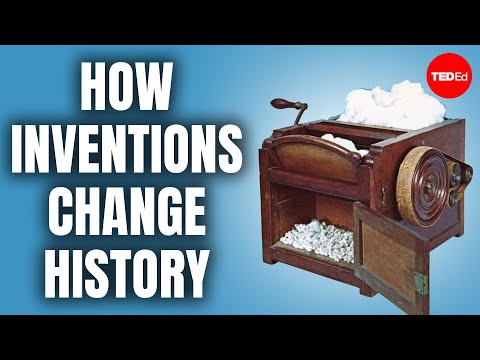
How Inventions Change History for Better and for Worse Kenneth C Davis
Invented in 1793, the cotton gin changed history for good and bad. By allowing one field hand to do the work of 10, it powered a new industry that brought wealth and power to the American South -- but, tragically, it also multiplied and prolonged the use of slave labor. Kenneth C. Davis lauds innovation, while warning us of unintended consequences.

The Bottom Billion Paul Collier
Around the world right now, one billion people are trapped in poor or failing countries. How can we help them? Economist Paul Collier lays out a bold, compassionate plan for closing the gap between rich and poor.

What If We Could Look Inside Human Brains Moran Cerf
The brain is what makes us function, yet we understand so little about how it works. We are learning more about the brain by using new technology to monitor epilepsy patients during surgery. Moran Cerf explains the process doctors use to explore the brain further.
How to Deal with Rejection
Rejection hurts. It’s incredibly painful to feel like you’re not wanted — and we do mean painful. Researchers found that we relate rejection to being “hurt,” using terms like “crushed” or “broken-hearted.” So, why does rejection trigger such a strong response, and is there any way to cope with this unique kind of pain? Explore common strategies to help you process this emotional experience.